
[Published: October 26, 2026 | Last updated: October 26, 2026]
TL;DR
- You can sometimes physically plug in a wrong charger, but you should not. The result ranges from a battery that never fully charges to overheating and fire.
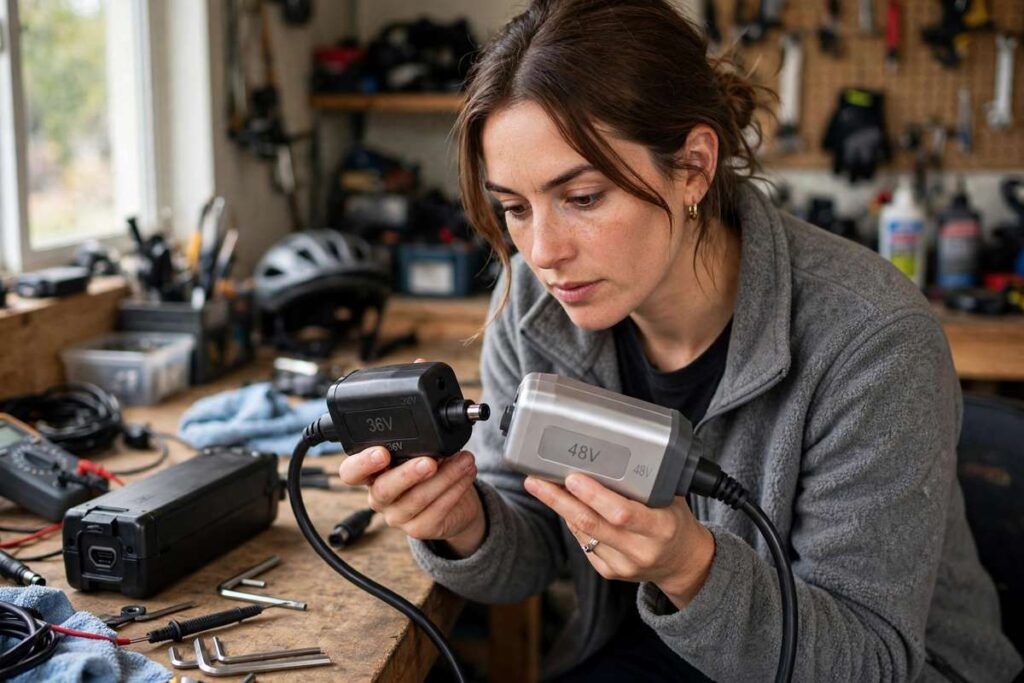
- A charger is “wrong” if its voltage, current rating, connector polarity, or charging profile does not match your battery.
- Of the four, voltage is the most dangerous mismatch. A 48V charger on a 36V pack pushes each cell far past its safe limit.
- The U.S. Consumer Product Safety Commission (CPSC) advises using only the charger that came with the device (CPSC, 2023).
- If you already used the wrong charger, unplug it, check for heat or swelling, and contact the manufacturer before charging again.
Can You Charge an Ebike Battery With the Wrong Charger?
No, you should not. A wrong charger may fit the port and still deliver the wrong voltage or current. The outcome depends on the mismatch: too little voltage leaves the battery undercharged, while too much can overheat the cells and cause a fire.
Ebike batteries use lithium-ion (Li-ion) cells, which tolerate very little error during charging. Each charger is built to supply the correct voltage and current for the pack it shipped with, and using a different one can be dangerous (Charged EVs, 2025).
CPSC staff counted 193 e-bike deaths from 2017 through 2023. Fourteen of those were tied to 8 lithium-ion battery fires (CPSC, 2024).
What Makes a Charger Wrong for Your Ebike Battery?
A charger is wrong when any one of four specs differs from what your battery needs: voltage, amperage, connector polarity, or charging profile. Matching the plug shape alone is not enough. All four specs are printed on the battery label and the charger label, so compare them side by side.
| Spec | What it means | Risk if mismatched |
|---|---|---|
| Voltage (V) | The electrical pressure the charger pushes into the pack | High |
| Amperage (A) | How much current flows per hour | Medium |
| Polarity | Which pin is positive and which is negative | High |
| Charging profile | How the charger tapers current as the battery fills | Medium |
Think of voltage as water pressure in a pipe. A hose rated for low pressure will burst if you connect it to a high-pressure line.
Your battery also contains a Battery Management System (BMS), a small circuit board that monitors cell voltage and temperature and cuts power when something is off. The BMS is a last line of defense, not a substitute for the right charger.
What Happens When the Charger Voltage Is Too High?
A charger with too much voltage can push cells beyond their safe limit, causing overheating, permanent damage, and possible fire. A Li-ion cell is fully charged at about 4.2V. A 36V pack has 10 cells in series (42V full), a 48V pack has 13 (54.6V), and a 52V pack has 14 (58.8V).
Put a 54.6V charger on a 36V pack and each cell sees about 5.46V if the BMS fails to cut off. That is 30 percent above the cell limit.
A good BMS may shut the charge down. A cheap or damaged one may not. Wrong voltage can damage cells permanently, and wrong current can cause overheating (Leoguar Ebikes, 2025).
What Happens When the Charger Voltage Is Too Low?
A low-voltage charger usually will not fill the battery. A 42V charger on a 48V pack delivers about 3.2V per cell, which is far below the 4.2V needed for a full charge. The battery may charge partway, show an error, or refuse to charge at all.
This is safer than overvoltage but still not harmless. Repeated partial charging with a mismatched charger can confuse the BMS and shorten pack life.
Do not “fix” a low-voltage charger by plugging two chargers in series. That produces an unregulated voltage with no charge control.
What Happens When the Amperage Is Different?
Amperage changes charging speed and heat. A charger with the correct voltage and a lower amp rating charges slowly but is generally fine. A charger with a higher amp rating than your BMS accepts can overheat the pack and its wiring. Higher amps charge faster but also create more heat (EM3ev, 2025).
Check the maximum charge current on your battery label. If the charger’s output is higher than that number, do not use it.
Standard ebike chargers are often rated around 2A, and fast chargers go higher. Fast chargers are designed for packs built to accept them.
Why a Matching Plug Does Not Mean a Compatible Charger
A plug that fits only proves the connector shape is the same. Ebike charging ports have no universal standard, and common types include XLR, barrel, and RCA connectors (Leoguar Ebikes, 2025). Two chargers can share the same barrel plug and have opposite polarity or different voltages.
Polarity is the most overlooked risk. On a barrel plug, the center pin may be positive on one brand and negative on another. Reversed polarity can short the circuit and damage the BMS.
A loose connector adds a second problem. A loose fit can cause arcing and heat at the port.
What Are the Warning Signs You Used the Wrong Charger?
Warning signs include a hot charger or battery, a swollen pack, a burning or chemical smell, hissing sounds, error lights, or a battery that never reaches full. Any of these means stop charging immediately. Normal charging warms the charger slightly, but it should never be too hot to touch comfortably.
Watch for these signs:
- The battery case feels hotter than the charger body.
- The pack looks puffy or the case seams have split.
- You smell something sharp or sweet near the battery.
- The charger’s indicator light never turns green after several hours.
- The bike shows a lower range than before the incident.
If you see smoke, swelling, or flames, move away and call your local emergency number. Do not try to put out a lithium-ion fire with a household extinguisher.
What Should You Do If You Already Used the Wrong Charger?
Unplug the charger from the wall first, then from the battery. Move the battery to a non-flammable surface, away from beds, sofas, and exits, only if it is safe to touch. Then inspect it. If it is warm, swollen, or smells odd, do not charge or ride it.
Follow these steps:
- Disconnect the charger from the wall, then from the battery.
- Let the battery sit for at least an hour in a safe spot and check it for heat or swelling.
- Compare the charger’s voltage, amperage, and polarity with the battery label.
- Contact the bike maker or battery seller and describe what happened.
- Do not charge the battery again until a professional or the manufacturer clears it.
A damaged pack can look normal and still fail later, so the manufacturer’s check is worth the wait.
How Common Are Ebike Battery Fires?
Ebike battery fires are less common than crashes but more deadly per incident. CPSC found motor vehicle accidents and control issues were the top hazards in e-bike deaths, while battery fires made up a smaller share (CPSC, 2024). The fire numbers are rising in dense cities, though.
In New York City, the fire department recorded 279 e-bike and e-mobility battery fires in 2024, up from 30 in 2019 (FDNY, as cited by Sen. Gillibrand’s office, 2025).
In London, Hammersmith and Fulham Council backed calls to stop sales of dangerous ebike and e-scooter chargers on popular websites (H&F Council, 2022).
CPSC’s advice is simple. Be present while charging, never charge while sleeping, and only use the charger that came with the device (CPSC, 2023).
How to Find the Right Replacement Charger
The right replacement charger matches your battery’s voltage, connector, polarity, and maximum charge current. Start with the battery label, then the manufacturer’s parts list. Buying the same model from the original brand is the safest route.
Use this checklist before buying:
- Read the battery voltage (36V, 48V, or 52V) and the charge cutoff voltage.
- Read the maximum charge current on the battery label.
- Match the connector type and the polarity diagram.
- Look for UL or CE certification and auto-cutoff on the charger.
- Avoid do-it-yourself chargers and uncertified adapters. They often lack precise current regulation, which raises the risk of overheating (EM3ev, 2025).
If the battery label is unreadable, ask the manufacturer with the serial number. Do not guess from the bike’s appearance.
Frequently Asked Questions About Charging an Ebike Battery With the Wrong Charger
Only if the manufacturer confirms compatibility. Matching voltage is necessary but not sufficient. An adapter can reverse polarity, and a loose connection can arc. Ask the battery maker before using any adapter.
Not unless the battery label allows that current. The BMS and cells are built for a maximum charge rate. A higher-amp charger on a pack that cannot accept it increases heat and fire risk.
Usually yes, if voltage, connector, and polarity all match. It takes longer to charge but is generally safe. Confirm the charger is certified and from a reputable maker.
The charger pushes about 54.6V into a pack built for 42V. If the BMS fails to cut off, the cells overcharge and can overheat. Do not do this.
It can. Many manufacturers exclude damage from non-approved chargers. Read your warranty terms, and keep the original charger.
CPSC advises being present while charging and never charging while sleeping (CPSC, 2023). Charge in a clear area, on a hard surface, away from exits and anything flammable.
A Battery Management System (BMS) is the circuit board inside the pack that monitors cells and cuts power during faults. It can block some bad charges, but cheap or damaged boards fail. Treat it as a backup, not a plan.
References
- U.S. Consumer Product Safety Commission, “Micromobility Products-Related Deaths, Injuries, and Hazard Patterns: 2017-2023” (2024): https://cpsc.gov/s3fs-public/Micromobility-Products-Related-Deaths-Injuries-and-Hazard-Patterns_2017-2023.pdf
- U.S. Consumer Product Safety Commission, “E-Scooter, E-Bike and Hoverboard Injuries and Deaths Are on the Rise” (2023): https://www.cpsc.gov/Newsroom/News-Releases/2023/E-Scooter-E-Bike-and-Hoverboard-Injuries-and-Deaths-Are-on-the-Rise-Celebrate-National-Fire-Prevention-Week-with-the-Safe-Use-of-Micromobility-Products
- Hammersmith & Fulham Council, “H&F calls for ‘fire risk’ e-bike chargers to be banned” (2022): https://www.lbhf.gov.uk/news/2022/09/hf-calls-fire-risk-e-bike-chargers-be-banned

Leave a Reply