
TL;DR
- Most fast drain comes from the bike or the conditions, not a dead battery. Assist level, tire pressure, cold, and load are the usual causes.
- Turbo mode can use up to 40% more energy than Eco mode (Upway, n.d.).
- A sudden range drop usually points to cold weather, soft tires, or brake drag. A slow drop over months points to cell aging.
- Lithium-ion packs from Bosch and Shimano are rated for roughly 500 to 1,000 full charge cycles before capacity falls noticeably (Cycling UK, 2024).
- Check tire pressure first. It takes two minutes and costs nothing.
What Counts as Fast Battery Drain on an Ebike?
Fast drain means your real range is well below what your battery size predicts. A simple estimate is to divide the battery’s watt-hour (Wh) rating by 15 to get miles, so a 500Wh battery gives about 33 miles (Cycling UK, n.d.). Heavy riders on hilly trails at high assist can see under 20 miles from the same pack.
Watt-hours measure stored energy, the same way a fuel tank measures liters. If your range is far below the estimate for your riding style, something is draining energy faster than it should.
Why High Assist Levels Drain the Battery Quickly
High assist levels drain the battery quickly because the motor draws more power the more help it gives. Turbo mode can use up to 40% more energy than Eco mode (Upway, n.d.). In maximum mode, a motor can deliver up to three times your own pedaling power (Upway, n.d.).
Think of assist level like a car’s accelerator. Holding it down gets you there faster and empties the tank sooner.
The fix is to use the lowest level that keeps you comfortable. Save the top level for steep climbs and starts from a standstill.
How Low Tire Pressure Cuts Ebike Range
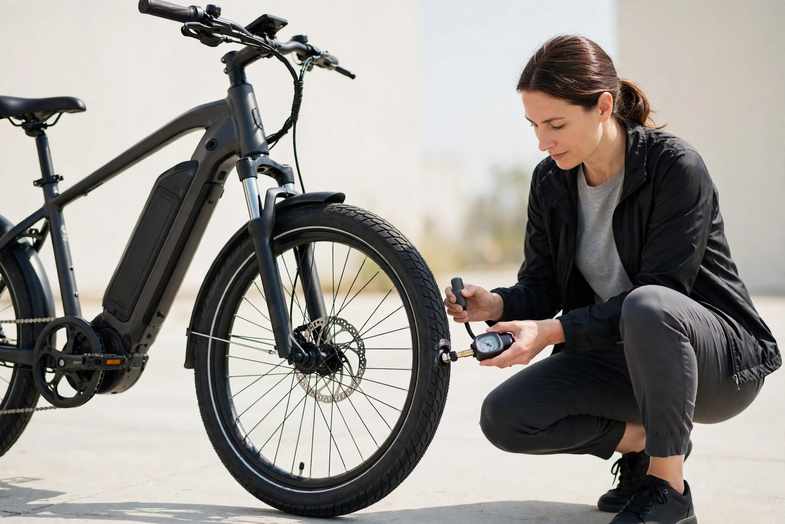
Low tire pressure cuts range because soft tires flatten more against the road, which raises rolling resistance. The motor then has to push harder to hold the same speed. Riding on soft tires is like walking on packed sand instead of pavement: the same effort covers less ground.
Check the pressure range printed on your tire sidewall. One guide suggests staying near 80% of the maximum rating (Upway, n.d.). Pressure in PSI (pounds per square inch) also drops as air cools, so a tire inflated in summer can be noticeably soft by winter.
Why Cold Weather Shrinks Ebike Range
Cold weather shrinks ebike range because low temperatures raise the internal resistance of lithium-ion cells, which makes the battery deliver power less efficiently. Riders in cold climates report a temporary range loss of 20% to 50% (EM3ev, n.d.). The loss is temporary and the cells recover when they warm up.
Three habits help:
- Store and charge the battery indoors at room temperature.
- Clip the battery onto the bike just before you ride.
- Pedal more on flat ground and keep assist low until the pack warms.
Heat is different. High temperatures during use or storage speed up permanent capacity loss (Flow Mountain Bike, n.d.).
How Terrain, Rider Weight, and Wind Increase Power Use
Hills, heavy loads, and headwinds increase power use because the motor does more work against gravity and drag. Climbing steep grades with a loaded bike can empty a battery in half the distance of a flat commute. Cargo, a backpack, and a passenger all add weight.
You can’t change the hills, but you can change your gearing. Shift to an easier gear on climbs so the motor and your legs share the load. Dropping assist by one level on a headwind stretch also saves charge.
Mechanical Drag: Brakes, Chain, and Wheels
Mechanical drag drains the battery because any part that rubs or resists forces the motor to compensate. A brake pad touching the rotor, a dry chain, or a stiff wheel bearing all add load. This often shows up as a range drop that appears overnight (Letrigo, n.d.).
Run two quick tests. Lift each wheel and spin it by hand: it should turn freely and for a few seconds. Then check that the brake pads clear the rotor on both sides. Clean and lube the chain, and wipe frost and dirt off the battery contacts, since poor connections waste energy.
How Battery Aging Reduces Capacity
Battery aging reduces capacity because lithium-ion cells lose storage ability with every charge cycle and with time. A charge cycle is one full charge’s worth of energy, and it can be spread across several top-ups. Bosch says its Smart System packs keep 80% of capacity after 1,000 cycles in lab conditions at 25°C (Upway, n.d.). Shimano guarantees at least 60% after 1,000 cycles (Cycling UK, n.d.).
Real-world results are worse than lab numbers. Three habits speed up aging:
- Heat during use or storage
- Frequent fast charging
- Leaving the pack fully flat or fully charged for long periods (Flow Mountain Bike, n.d.)
Aging looks like a gradual range loss over months, not a sudden drop. If your bike shows a cycle count on the display, compare it to your manufacturer’s rating.
How to Tell Which Cause Is Draining Your Battery
Match your symptom to the likely cause, then run the test in the right-hand column.
| Symptom | Likely cause | Test |
|---|---|---|
| Range dropped overnight | Cold, soft tires, brake drag, loose contacts | Check PSI, spin each wheel, clean terminals |
| Range dropped slowly over months | Cell aging | Compare cycle count to manufacturer rating |
| Percentage falls fast under load, then recovers | Voltage sag from cold or aging cells | Ride the same flat route warm and cold (Letrigo, n.d.) |
| Poor range only on certain routes | Hills, wind, or cargo | Lower assist and compare |
If a fully charged battery still dies quickly after you have ruled out the causes above, have a shop load-test the pack.
Common Mistakes That Make Ebike Battery Drain Worse
These habits are the most frequent self-inflicted causes of short range:
- Riding in Turbo all the time, including on flat ground.
- Never checking tire pressure between rides.
- Leaving the battery in a cold garage or a hot car.
- Storing the pack at 0% or 100% for weeks.
- Blaming the battery before checking brakes and tires.
Frequently Asked Questions About Ebike Battery Drain
Why does my ebike battery drain so fast all of a sudden?
A sudden drop usually comes from cold weather, low tire pressure, brake drag, or a loose battery contact. Cell aging is gradual and rarely causes an overnight change. Check PSI and spin the wheels first.
Does cold weather permanently damage an ebike battery?
No, cold causes a temporary range loss that reverses when the battery warms up. Heat is the bigger risk for permanent damage. Charge and store the pack indoors at room temperature.
How many charge cycles does an ebike battery last?
Most modern lithium-ion ebike batteries last between 500 and 1,000 full charge cycles before capacity falls noticeably (Cycling UK, 2024). The battery keeps working after that, but with less range.
Does low tire pressure really reduce ebike range?
Yes. Softer tires raise rolling resistance, so the motor uses more energy to hold your speed. Keep pressure inside the range printed on the sidewall.
Which assist level saves the most battery?
The lowest assist level you can ride comfortably saves the most. Eco uses far less energy than Turbo, which can draw up to 40% more (Upway, n.d.).
How do I know if my ebike battery is actually failing?
Look for a steady range decline over months, a high cycle count, or error codes on the display. A shop can load-test the pack to measure real capacity and internal resistance.
A sudden drop usually comes from cold weather, low tire pressure, brake drag, or a loose battery contact. Cell aging is gradual and rarely causes an overnight change. Check PSI and spin the wheels first.
No, cold causes a temporary range loss that reverses when the battery warms up. Heat is the bigger risk for permanent damage. Charge and store the pack indoors at room temperature.
Most modern lithium-ion ebike batteries last between 500 and 1,000 full charge cycles before capacity falls noticeably (Cycling UK, 2024). The battery keeps working after that, but with less range.
Yes. Softer tires raise rolling resistance, so the motor uses more energy to hold your speed. Keep pressure inside the range printed on the sidewall.
The lowest assist level you can ride comfortably saves the most. Eco uses far less energy than Turbo, which can draw up to 40% more (Upway, n.d.).
Look for a steady range decline over months, a high cycle count, or error codes on the display. A shop can load-test the pack to measure real capacity and internal resistance.
Quick Fix Checklist
- Check tire pressure before every ride.
- Drop one assist level.
- Keep the battery warm and charge it indoors.
- Spin both wheels and check the brakes.
- Avoid storing the battery empty or full.
References
- Cycling UK, “Guide to e-cycle batteries”
- Flow Mountain Bike, “Bosch Powertube battery tips and range factors”
- Upway, “Why Does My Electric Bike Battery Drain So Fast?”

Leave a Reply