
[Published: October 25, 2026 | Last updated: October 25, 2026] | 6 min read
TL;DR
- Charge a new e-bike battery to 100% with the charger that came in the box, in a dry room at normal room temperature, before your first ride.
- Most new e-bike batteries are lithium-ion, and they do not need a special “activation” process or a full drain before the first charge (Letrigo, accessed 2026).
- Brands give different first-charge times: SUPER73 says six to eight hours (SUPER73, accessed 2026), while Velio says 12 hours (Velio, accessed 2026). Your manual overrides any general guide.
- Stay home and awake during the charge. The U.S. Consumer Product Safety Commission (CPSC) says never charge batteries for micromobility products while sleeping (CPSC, 2024).
- After the first full charge, partial top-ups are fine.
What Is the Right Way to Charge an Ebike Battery for the First Time?
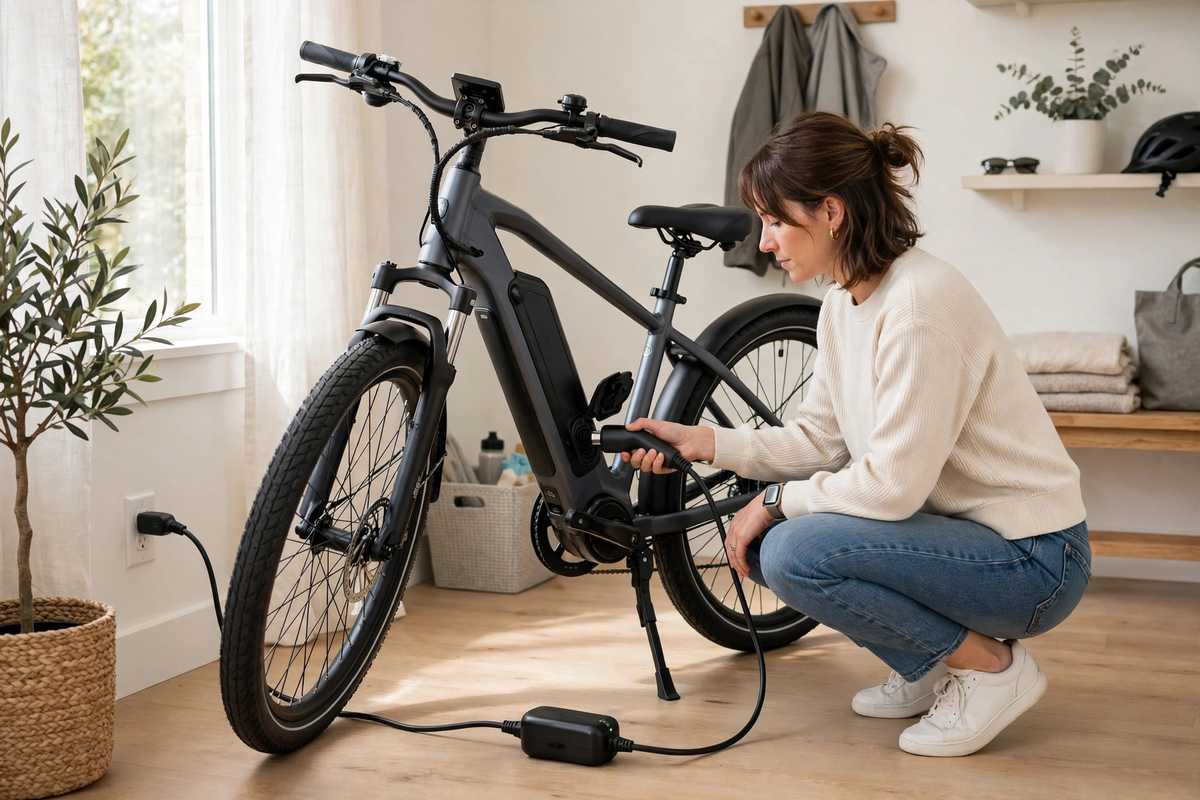
The right way is to read the manual, check the battery and charger for damage, and charge to 100% before your first ride. Use only the original charger. Charge on a hard, dry, uncluttered surface at room temperature.
A lithium-ion battery is a rechargeable battery that stores energy in lithium-based cells. Nearly every modern e-bike uses one. Unlike old nickel batteries, it has no “memory”, so it needs no special break-in routine.
What You Need Before You Start
You need four things: the battery, the charger from the same box, a wall outlet, and a safe spot to charge. Gather them before you begin.
The manual for your specific e-bike, because charging times and indicator lights differ by brand.
The original charger. Unapproved third-party chargers may not regulate voltage correctly or communicate properly with the battery (Tern Bicycles, accessed 2026).
A wall outlet. The New York City Fire Department (FDNY) says to never charge an e-bike battery with an extension cord or power strip (FDNY, 2023).
A hard, non-flammable surface such as a tile or concrete floor. Avoid beds, sofas, and carpet.
Step 1: Inspect the Battery and Charger for Damage
Look at the battery case, the charging port, the charger cable, and the plug before connecting anything. A cracked case, bent pins, a frayed cable, or a swollen battery means you should stop and contact the seller.
Shipping can damage a battery. A safe inspection takes under a minute and removes the most common fire risk.
Never charge a battery that smells odd, feels hot, or has changed shape. The Insurance Association for Electrical Inspectors lists these as stop-use signs: unusual odor, change in color, too much heat, change in shape, leaking, or smoking (IAEI Magazine, 2023).
Step 2: Let the Battery Reach Room Temperature
A battery that sat in a cold truck or hot warehouse should rest indoors before charging. Wait until it feels the same temperature as the room, which usually takes one to two hours.
Charging a very cold or very hot battery strains the cells. Letrigo advises letting the battery return to a moderate temperature first (Letrigo, accessed 2026).
Step 3: Set Up a Safe Charging Spot
Choose a dry room with open air around the battery, away from exit doors and anything that can burn. Do not cover the battery or charger while it charges.
The National Fire Protection Association (NFPA) advises storing e-bikes and batteries away from exit doors and anything that can get hot or catch fire (IAEI Magazine, 2023).
Step 4: Connect the Charger and Start Charging
Plug the charger into the battery first, then into the wall outlet, unless your manual gives a different order. Confirm the charger light switches on and the battery indicator starts to move.
If the battery is removable, you can charge it off the bike. If it is built in, plug the charger into the bike’s charging port.
Step 5: Charge to 100% and Stay Nearby
Charge until the indicator shows full, and stay home and awake while it runs. A normal charge takes one to several hours, depending on the power of the charger (MHW-Bike, accessed 2026).
Check on the battery every hour or so. It should feel warm at most, never hot.
Step 6: Unplug Once the Battery Is Full
Unplug the charger from the wall first, then from the battery. A battery that reaches 100% does not need to stay connected.
The IAEI Magazine safety guidance tells riders not to keep charging the device or device battery after it is fully charged (IAEI Magazine, 2023).
Should You Charge for 6, 8, 12, or 24 Hours the First Time?
Follow your manual. Brand advice varies, and no single number fits every battery.
| Source | First-charge advice |
|---|---|
| SUPER73 | Leave on the charger 6 to 8 hours to condition the cells |
| Velio | Charge 12 hours so current flows through all cells |
| Letrigo | Charge to full and unplug, no extra-long charge |
| One forum-quoted manual | Three full discharges, then a 24-hour charge |
The long-charge advice exists because a battery management system (BMS), the circuit board that balances the cells and stops charging at full, needs time to equalize new cells. Think of it like a teacher waiting for every student to finish before the class moves on.
The full-discharge advice is the outlier. Lithium-ion batteries have no memory effect, and a full discharge will not “condition” the pack (Electric Bike Report forum, accessed 2026). Letrigo agrees that a new lithium-ion battery does not need a full drain before the first charge (Letrigo, accessed 2026).
If your manual calls for a long first charge, do it during the day while you are home. This follows both the manufacturer and the CPSC rule against charging while asleep.
What to Do After the First Full Charge
Ride normally and charge when needed. After the first charge, partial top-ups are fine, and you do not need to wait for the battery to hit zero.
SUPER73 suggests charging as soon as the battery is below 50% and before it reaches 10% (SUPER73, accessed 2026). For daily rides, charging to 80-90% instead of 100% can reduce stress on the cells, per Leoguar Bikes (accessed 2026).
Battery life is finite. Raleigh states a lithium-ion battery is generally capable of between 500 and 1,000 charging cycles (Raleigh, accessed 2026). Good habits stretch that number.
Common Problems During the First Charge and How to Fix Them
| Problem | Likely Cause | Solution |
|---|---|---|
| Charger light stays off | Loose plug or dead outlet | Reseat both ends, try another wall outlet |
| Battery will not start charging | Battery is very cold or very hot | Move it indoors, wait until it reaches room temperature |
| Indicator never reaches full | Charger mismatch or faulty cell | Confirm the charger model, then contact the seller |
| Battery feels hot | Poor ventilation or a fault | Unplug, move it to a hard surface, call the seller |
| Case looks swollen or smells odd | Damaged cells | Stop using it and contact the manufacturer |
Why Charging Safety Matters From Day One
Lithium-ion batteries store a lot of energy, so bad charging habits can start fires. From January 1, 2021 to November 28, 2022, the CPSC received reports of 208 micromobility fire or overheating incidents, resulting in at least 19 fatalities (CPSC via IAEI Magazine, 2022).
In the first six months of 2023, the FDNY reported over 200 fires and 11 deaths linked to e-bikes in New York City (FDNY, 2023).
Buy products tested by an accredited lab. The standards are UL 2849 for the full e-bike electrical system and UL 2271 for the battery, where UL means Underwriters Laboratories (Tern Bicycles, accessed 2026).
Frequently Asked Questions About Charging an Ebike Battery for the First Time
How long should I charge a new ebike battery?
Charge it for the time in your manual. Brands range from “until full” to 6-8 hours or 12 hours. If the manual says nothing, charge until the indicator shows 100% and then unplug.
Do I need to drain a new ebike battery before charging it?
No. Modern lithium-ion e-bike batteries do not need a full drain before the first charge (Letrigo, accessed 2026). Draining to zero can stress the cells, so skip it unless your manual explicitly requires it.
Can I ride my new ebike before charging it?
Most new batteries ship partly charged, but manufacturers recommend a full charge before the first ride (Geekay Bikes, accessed 2026). A full first charge gives you an accurate range reading and lets the BMS balance the cells.
Can I stop the first charge before it reaches 100%?
Yes, in most cases, but a full first charge is the standard advice. Stopping early will not harm the battery. It may leave the cells less balanced, so a complete charge is the safer default.
Is it safe to charge an ebike battery overnight?
No. The CPSC says to be present during charging and never charge while sleeping (CPSC, 2024). Charge during the day, and unplug once the battery is full.
Can I use a different charger if I lose the original?
Use only a charger approved by the e-bike manufacturer or certified by an accredited lab. Mismatched chargers can overcharge a battery and cause overheating (FDNY, 2023).
Quick Recap of the First Charge Steps
- Read the manual and use the original charger.
- Inspect the battery and charger for damage.
- Let the battery reach room temperature, then charge on a hard, dry surface with no extension cord.
- Charge to 100% while you are home and awake.
- Unplug the charger when the battery is full.
References
U.S. Consumer Product Safety Commission – Public health and safety notice on e-bike batteries: https://www.cpsc.gov/node/59554
Letrigo – Tips for Charging Your New E-bike Battery for the First Time: https://letrigo.com/blogs/knowledge/charge-ebike-battery-first-time
IAEI Magazine – Navigating Lithium-ion Battery Safety for E-Bikes: https://iaeimagazine.org/columns/certification-insights/navigating-lithium-ion-battery-safety-for-e-bikes/

Leave a Reply