
TL;DR
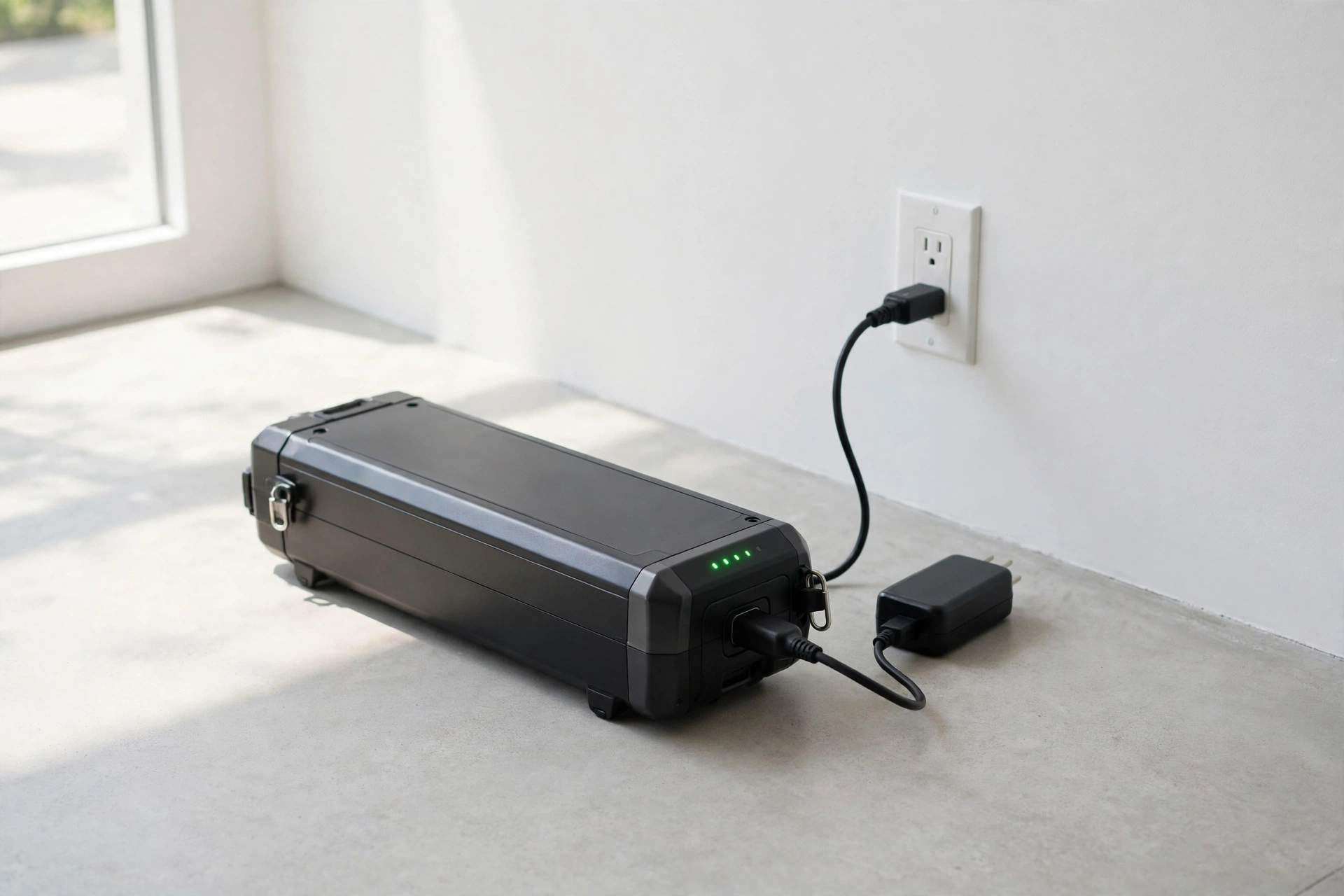
- Charge your e-bike battery with its original charger, plugged straight into a wall outlet, while you are awake and in the room or next door.
- Unplug the battery once it is full, and never charge it on a bed, couch, or near an exit door, per the National Fire Protection Association (NFPA, 2025).
- The U.S. Consumer Product Safety Commission (CPSC) counted 227 lithium-ion micromobility incidents from 2019 to 2023, and 86% were fires (CPSC, 2026).
- Stop using any battery that smells odd, swells, overheats, leaks, or smokes.
- If a battery ignites, leave the building and call emergency services. Do not try to put it out.
What Is Ebike Battery Fire Safety and Why It Matters at Home
Ebike battery fire safety is the set of habits that keep a lithium-ion battery from overheating while it charges, sits in storage, or runs on the road. A lithium-ion battery is the rechargeable type used in phones, laptops, and e-bikes (also written ebikes). It packs a lot of energy into a small case, so one fault can become a fire quickly.
The CPSC identified 227 lithium-ion battery incidents in micromobility products between 2019 and 2023. Of these, 195 were fires, and those fires caused all 39 deaths and 174 of the 181 injuries. (CPSC, 2026). Micromobility products are small personal vehicles such as e-bikes, e-scooters, and hoverboards.
Local data shows the same trend. E-bike and e-mobility battery fires in New York City rose from 30 in 2019 to 279 in 2024 (Fire Department of the City of New York, FDNY, 2024).
Batteries can also fail when nobody is using them. The CPSC logged 23 spontaneous or at-rest incidents, with 4 deaths and 36 injuries (CPSC, 2026). In 2025 the agency warned owners of certain Rad Power Bikes batteries after 31 reported fires, some during storage, and about 24,000 batteries were recalled (CPSC, 2025).
How Do E-Bike Batteries Catch Fire? Thermal Runaway Explained
E-bike batteries catch fire through thermal runaway, a self-feeding reaction in which one failing cell heats its neighbors until the whole pack burns. The reaction produces intense heat, toxic smoke, and in the worst cases explosions (BikeTips, 2026). Picture a row of dominoes where each falling piece knocks over the next, only much faster.
Several situations can start that chain:
- A mismatched or aftermarket charger can push the wrong voltage or current into the pack.
- Water reaching the battery or its connectors can short-circuit cells.
- A crash or drop can damage cells inside the case even when the outside looks fine.
- A homemade pack lacks the factory-tested battery management system (BMS), the circuit board that monitors voltage and temperature. Homemade packs were tied to 4 incidents and 3 deaths in the CPSC data (CPSC, 2026).
How to Charge an E-Bike Battery Safely at Home: 8 Steps
Charge an e-bike battery with the original charger, plugged directly into a wall outlet, on a hard surface, while you are awake and nearby, and unplug it when it is full. These rules follow NFPA and CPSC guidance and address the most common home charging risks.
Buy certified equipment. Look for UL 2849 on complete e-bikes, UL 2271 on replacement battery packs, and UL 2272 on scooters and similar devices. UL (Underwriters Laboratories) is an independent safety testing lab.
Use only the battery and charger made for your bike. NFPA advises using only the battery and charger that were designed for the device and came with it (NFPA, 2022).
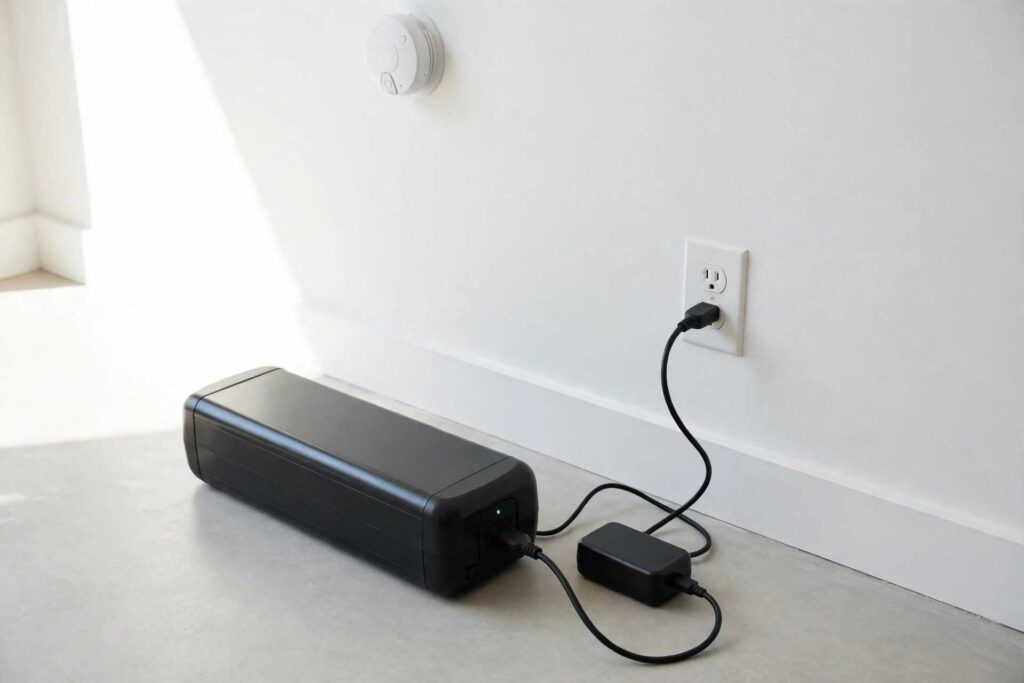
Plug into a wall outlet, not an extension cord. Charge one battery at a time so you do not overload the circuit (NFPA, 2022).
Stay present. The CPSC says to be there whenever you charge and never to charge while sleeping (CPSC, 2023).
Charge on a hard, flat, dry surface. NFPA says not to charge on a pillow, bed, or couch (NFPA, 2025). Keep the battery away from curtains, paper, liquids, direct sunlight, and children.
Mind the temperature. NFPA says not to charge below 32°F (0°C) or above 105°F (40°C) (NFPA, 2025). After a ride, let a warm battery cool to room temperature before you plug it in.
Unplug when the battery is full. NFPA recommends against continuing to charge after it reaches 100% (NFPA, 2022).
Put a working smoke alarm near the charging spot, and test it monthly.
Where Should You Store and Charge an E-Bike at Home?
Store and charge an e-bike on a hard floor in a room with a working smoke alarm, away from exit doors, heat sources, and anything that burns. Never place it where a fire would block your way out. This table compares common spots.
| Location | Verdict | Reason |
|---|---|---|
| Bed, couch, or carpeted bedroom | Avoid | Soft furnishings burn easily and trap heat. |
| Hallway or beside the front door | Avoid | A fire here cuts off your exit. NFPA says to store e-bikes away from exit doors. |
| Hot car or sunny window | Avoid | NFPA says not to store batteries in direct sunlight or hot vehicles. |
| Hard floor in a living area with a smoke alarm | Better | You can see, smell, and hear problems early. |
| Covered outdoor space or detached garage in mild weather | Best when practical | A fire starts away from where you sleep. Keep the temperature within 32°F to 105°F. |
What Are the Warning Signs of a Failing E-Bike Battery?
Stop using an e-bike battery immediately if it has an unusual odor, changes color, gets too hot, changes shape, leaks, smokes, makes odd noises, or no longer holds a charge. These are the failure signs listed by NFPA (NFPA, 2025).
If you notice one, take these actions:
- Unplug the charger if you can do so safely.
- Move the battery away from anything flammable, but only if it is safe to touch.
- Call emergency services if you see smoke, flames, or swelling that is getting worse.
- Do not charge or ride with that battery again, even if it seems to recover.
- Have repairs done only by a qualified professional.
What to Do If an E-Bike Battery Catches Fire
Leave the building immediately, do not fight the fire, and call your local emergency number (911 in the US). NFPA says lithium-ion battery fires give off toxic gases and burn extremely hot (NFPA, 2022), which is why it tells people not to attempt to put them out.
Get every person and pet out first. Tell the dispatcher that the fire involves a lithium-ion e-bike battery so responders arrive prepared. Do not go back inside for the bike.
Common Ebike Battery Charging Mistakes to Avoid
The five most common mistakes are charging overnight, using a cheap replacement charger, leaving the battery plugged in after it is full, charging a damaged pack, and throwing an old battery in the trash. Each one has a simple fix.
Charging overnight removes the one thing that limits a fire: someone awake who can react. Charge in the afternoon or evening instead.
A third-party charger may not match your battery. Buy a replacement only from the bike or battery maker.
Leaving a full battery on the charger adds stress with no benefit. Set a phone timer when you plug in.
A dented, swollen, or wet battery is unsafe even if it still charges. Retire it.
Lithium-ion batteries can start fires in garbage trucks and bins. Take old packs to a battery recycling location, which you can find at call2recycle.org.
Frequently Asked Questions About Ebike Battery Fire Safety
Is it safe to charge an e-bike battery overnight?
No. The CPSC advises never charging lithium-ion batteries while you sleep (CPSC, 2023). A fault during the night means nobody notices smoke or heat until the fire has grown.
Can I charge my e-bike inside my apartment?
Yes, if you follow the steps above and your building allows it. Charge on a hard surface near a smoke alarm, away from exits, while you are present. Some buildings ban charging indoors, so check your lease or house rules.
How long should I charge an e-bike battery?
Charge until the battery is full, then unplug it. Charge time varies by battery size and charger, so check your manual for the expected duration and set a timer.
Is it safe to use a cheaper replacement charger?
Not unless the manufacturer made it for your battery. Aftermarket batteries and chargers are listed among the incident categories the CPSC tracks (CPSC, 2026). Match the charger to the model printed in your manual.
What temperature is safe for charging an e-bike battery?
Between 32°F (0°C) and 105°F (40°C), per NFPA (NFPA, 2025). Bring the battery indoors from a freezing garage and let it reach room temperature before you plug it in.
Are there federal rules for e-bike batteries?
Not yet final. On June 24, 2026, the CPSC published a proposed rule (16 CFR 1265) covering lithium-ion batteries in e-bikes and related products (CPSC, 2026). Until a rule takes effect, certification labels such as UL 2849 and UL 2271 are your best signal of a tested product.
No. The CPSC advises never charging lithium-ion batteries while you sleep (CPSC, 2023). A fault during the night means nobody notices smoke or heat until the fire has grown.
Yes, if you follow the steps above and your building allows it. Charge on a hard surface near a smoke alarm, away from exits, while you are present. Some buildings ban charging indoors, so check your lease or house rules.
Charge until the battery is full, then unplug it. Charge time varies by battery size and charger, so check your manual for the expected duration and set a timer.
Not unless the manufacturer made it for your battery. Aftermarket batteries and chargers are listed among the incident categories the CPSC tracks (CPSC, 2026). Match the charger to the model printed in your manual.
Between 32°F (0°C) and 105°F (40°C), per NFPA (NFPA, 2025). Bring the battery indoors from a freezing garage and let it reach room temperature before you plug it in.
Not yet final. On June 24, 2026, the CPSC published a proposed rule (16 CFR 1265) covering lithium-ion batteries in e-bikes and related products (CPSC, 2026). Until a rule takes effect, certification labels such as UL 2849 and UL 2271 are your best signal of a tested product.
Quick Safety Checklist Before You Plug In Tonight
- The charger is the one that came with your bike or was made by its manufacturer.
- The plug goes straight into a wall outlet.
- The battery sits on a hard surface, away from bedding, exits, and sunlight.
- You will be home and awake until it is full.
- A working smoke alarm is within hearing range.
References
- NFPA, “E-Bike and E-Scooter Safety” tip sheet and resources
- U.S. CPSC news release, “E-Scooter, E-Bike and Hoverboard Injuries and Deaths Are on the Rise”
- U.S. CPSC, “Important Safety Information Concerning Micromobility Devices” (December 2022)

Leave a Reply