
TL;DR
- To fix a flat on a rear hub motor ebike, power off the bike, unplug the motor cable, remove the wheel, repair or replace the inner tube, then reinstall the wheel and reconnect the cable.
- The repair has 7 steps. Hovsco’s repair guide calls it a 30-minute job once you know the routine.
- The only differences from a regular bike flat are the motor cable and the extra weight of the wheel.
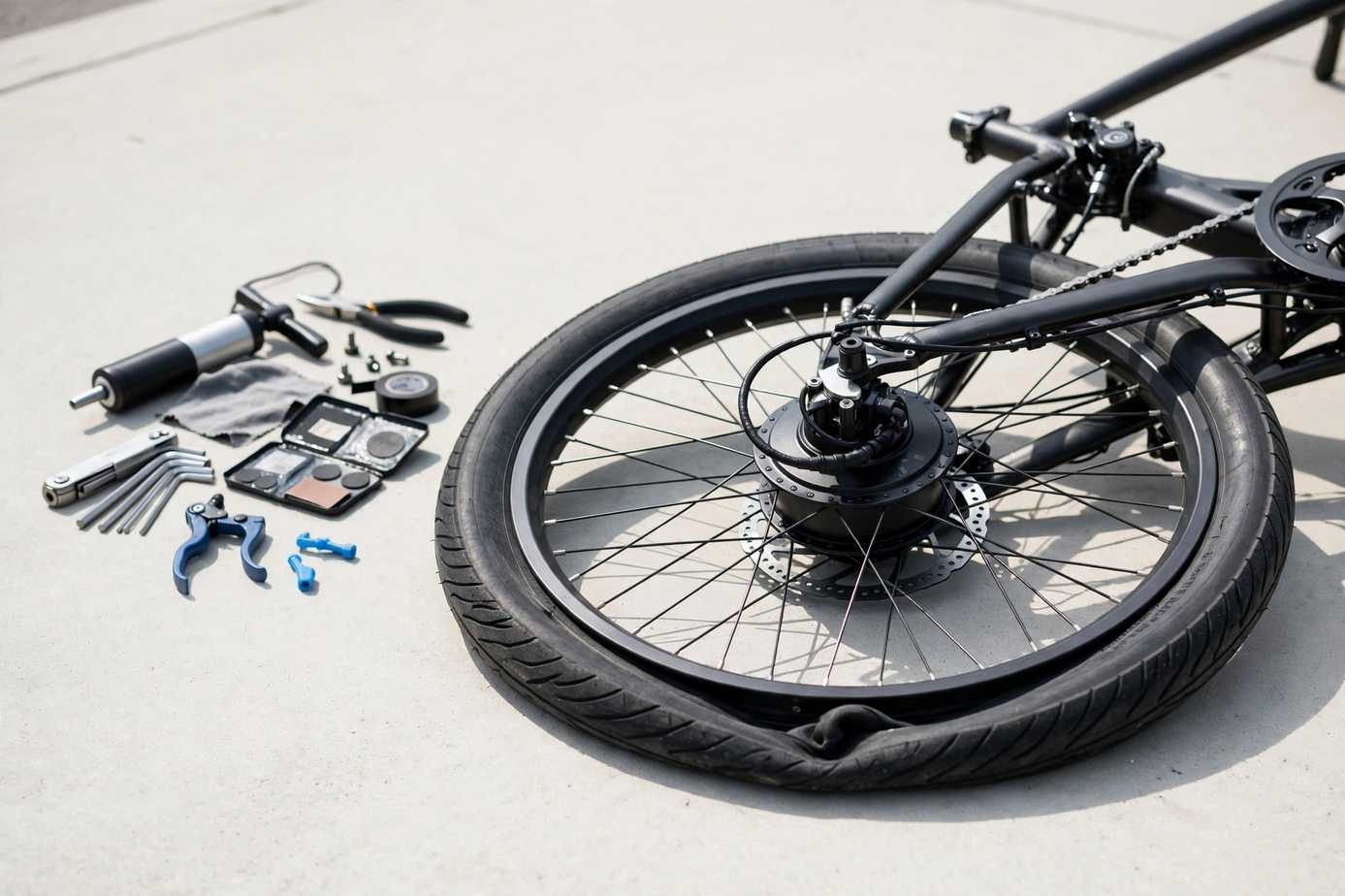
- You need tire levers, a spare tube or patch kit, a pump, the right wrench or hex key for your axle, and a few spare zip ties.
- Find what caused the puncture before you fit a new tube, or the flat will come back.
What Makes a Rear Hub Motor Flat Different From a Regular Bike Flat
A rear hub motor flat is repaired the same way as any bike flat, with two extra tasks: unplugging the motor cable and handling a heavier wheel. A hub motor is an electric motor built into the center of the wheel. It gets power through a cable that runs to the bike’s controller, the box that manages motor output.
Think of that cable like a phone charger plugged into a wall. If you pull the wheel away while it is still connected, something tears or bends. That is why every manufacturer guide starts with disconnecting it (Schwinn Support).
Front hub motors and mid-drive motors (motors at the pedals) are easier. A mid-drive bike with a derailleur loses nothing special when the rear wheel comes off. An internal gear hub adds complexity, and Upway advises seeing a professional if you are unsure.
What Tools and Parts You Need Before You Start
You need six items for this repair: tire levers, a spare tube or patch kit, a pump, wrenches or hex keys that fit your axle nuts, zip ties, and a phone for a reference photo. Check your axle hardware first, because ebikes use bolt-on axles instead of the quick-release levers found on many regular bikes.
- Tire levers (two or three) to pry the tire off the rim.
- A spare inner tube in the exact size printed on your tire sidewall, or a patch kit.
- A pump that reaches the pressure printed on the sidewall, shown in PSI (pounds per square inch).
- A wrench or socket that matches your axle nuts, plus hex keys for the torque arm if your bike has one.
- New zip ties to re-secure the motor cable.
A repair stand that can hold ebike weight puts the wheel at a comfortable height, according to Leoguar Bikes. A kickstand works if you do not have one.
How to Fix a Rear Hub Motor Flat Tire: 7 Steps
The full repair takes seven steps in a fixed order: power down, prepare the drivetrain, unplug the motor, remove the wheel, fix the tube, refit the tire, and reinstall. Skipping the early steps is how people damage wiring or restart the motor by accident.
Step 1: Power Off the Bike and Remove the Battery
Turn the display off, then take the battery out if your bike allows it. This prevents the motor from engaging while your hands are near the wheel and avoids short circuits at the connectors. Lower the kickstand or put the bike on a stand so it stays steady (Schwinn Support).
Step 2: Prepare the Drivetrain and Brakes
Shift the chain onto the smallest rear cog. This loosens the derailleur and makes the wheel easier to remove and refit. If you have rim brakes, release the brake mechanism so the tire can pass between the pads.
With disc brakes, do not squeeze the brake lever once the wheel is out. The pads can close and make refitting the rotor hard.
Step 3: Disconnect the Motor Cable
Find the motor connector near the rear axle, usually on a chainstay (the frame tubes running back from the pedals). Cut any zip ties holding the cable to the frame, and remove any C-shaped clips. Do not cut the cable itself (Schwinn Support).
Pull the plug apart by gripping the connector housing, never the wire. Before you unplug it, photograph the cable routing and connector orientation so you can match it later (Leoguar Bikes).
Step 4: Remove the Axle Nuts and Lift Out the Wheel
Loosen the axle nuts or bolts on both sides. If your bike has a torque arm, which is a metal bracket that stops the motor axle from spinning in the frame, loosen or remove it first. Note the order of any washers as they come off.
Support the wheel with both hands and pull it straight back. Hub motor wheels are heavier than regular wheels, and pulling at an angle can stress the wiring (VTUVIA). Lay the wheel down with the motor side up so the cable and housing are not crushed (Really Good Ebikes).
Step 5: Find the Cause and Repair or Replace the Tube
Let the air out, work one tire lever under the bead (the tire edge that sits inside the rim), and pull the tube out. Then check the cause of the puncture before doing anything else. Run a cloth carefully along the inside of the tire to feel for glass or thorns, and check the rim tape for exposed spoke holes.
If the hole is small, a patch works. If the tube has a split near the valve or several holes, replace it. Hovsco recommends inspecting the casing for the cause before reinstalling.

Step 6: Refit the Tire and Inflate It
Put a little air in the new tube so it holds its shape, seat it inside the tire, and push the bead back onto the rim by hand. Work around the rim and avoid levers on the final section, since they can pinch the tube.
Inflate to the pressure printed on your tire sidewall. Spin the wheel and check that the tire sits evenly on both sides.
Step 7: Reinstall the Wheel and Reconnect the Motor
Slide the axle into the dropouts (the slots in the frame where the axle sits), with washers in their original order. Tighten the axle nuts evenly to the torque specified in your bike’s manual, as Hovsco advises. Refit the torque arm if you removed one, and check that the wheel is centered between the chainstays.
Reconnect the motor plug by aligning the markings and pushing until it is secure (Schwinn Support). Re-secure the cable with new zip ties, put the battery back, power on, and test at the lowest assist level before riding off.
Common Problems and How to Fix Them
Most problems during this repair come from three places: stuck axle nuts, a wheel that will not drop out, and a motor that does not run after reassembly. The table below lists the likely cause and the fix for each.
| Problem | Likely Cause | Solution |
|---|---|---|
| Axle nuts will not loosen | Over-tightened or corroded hardware | Use a longer wrench for leverage and apply penetrating oil. |
| Wheel will not come out | Motor cable still attached, or torque arm still fitted | Check the cable and remove the torque arm. |
| Wheel will not go back in | Chain tension or washer order | Shift to the smallest cog and check the washers. |
| Motor does not run after reinstall | Plug not fully seated | Reconnect, aligning the markings until it clicks into place. |
| Tire goes flat again quickly | Cause was never removed | Inspect tire and rim tape and replace the tube. |
Can You Fix the Flat Without Removing the Wheel?
Yes, in an emergency. You can break the tire bead on one side, pull a section of the tube out through the gap, patch it, and push it back in (Electric Bike Review forum). This avoids unplugging the motor, but it only suits a clean puncture.
It is harder to find the cause this way, and patching in place is easier to get wrong. Treat it as a roadside backup and do the full repair at home.
How to Prevent Rear Hub Motor Flats
Keeping the tire at the pressure printed on the sidewall is the simplest prevention, since low pressure causes most pinch flats. Check it every week or two. Inspect the tread for embedded debris after rides, and replace tires once the tread is worn.
Carry a spare tube and a mini pump on every ride. A rear flat far from home is much easier when the tools are already in your bag.
Frequently Asked Questions
Power off the bike, disconnect the motor cable, remove the wheel, repair or replace the tube, and reinstall. The tube work is identical to a regular bike once the wheel is off.
Yes. The cable runs from the frame to the hub, so the wheel cannot come out until it is unplugged. Disconnecting it also prevents electrical damage to the wiring (Really Good Ebikes).
Hovsco puts it at about 30 minutes for someone who knows the steps. Expect longer the first time, mostly for stuck axle nuts and finding the puncture.
Use the size printed on your tire sidewall, which lists diameter and width. Fat tire ebikes need a fat tire tube, so a standard tube will not fit.
Yes, if the hole is small and the tube is otherwise in good shape. Replace the tube if it has a split near the valve or several holes.
The rear is harder because of the chain, derailleur, and drivetrain alignment on top of the motor cable. Upway notes that a front wheel or a mid-drive bike is easier than a rear hub motor.
Quick Recap of the 7 Steps
- Power off the bike and remove the battery.
- Shift to the smallest rear cog and release rim brakes if you have them.
- Unplug the motor cable and cut the zip ties.
- Loosen the axle nuts and lift the wheel out.
- Find the cause and patch or replace the tube.
- Refit the tire and inflate to sidewall pressure.
- Reinstall the wheel, torque the nuts, reconnect the motor, and test.
References
- Schwinn Support, “How to fix a flat tire on your electric bike or scooter”: https://help.schwinnbikes.com/hc/en-us/articles/7329627736983-How-to-fix-a-flat-tire-on-your-electric-bike-or-scooter
- Hovsco, “How to Fix a Flat Tire on an E-Bike”: https://www.hovsco.com/blogs/knowledge-base/how-to-fix-a-flat-tire-on-an-e-bike
- Electric Bike Journal, “How to Remove an eBike Rear Wheel”: https://www.electricbikejournal.com/how-to-remove-ebike-rear-wheel

Leave a Reply