
Published: June 17, 2026 | Last updated: June 17, 2026 | 9 min read
TL;DR
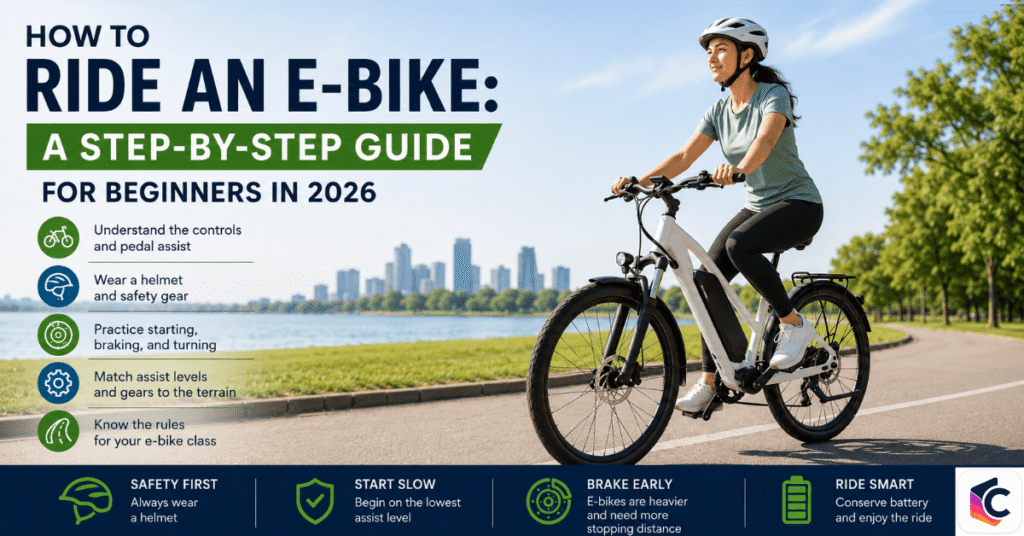
- E-bikes respond differently from regular bikes because pedal assist adds power the instant you pedal, so start your first ride on the lowest assist setting.
- Class 1 e-bikes cap pedal assist at 20 mph and Class 3 models assist up to 28 mph (CalBike, 2026), so match the assist mode to where you’re riding.
- E-bikes weigh more than standard bicycles and need more stopping distance, so practice braking before riding in traffic.
- Only 44% of e-bike riders treated for injuries in emergency departments were wearing a helmet (NPR, 2024), making a helmet the single most important piece of gear.
- Plan for 2-3 short practice sessions in an empty parking lot before your first ride on a street or trail.
What You Need Before You Start
- A helmet that fits snugly and sits level on your head, not tilted back.
- An e-bike adjusted to your height, with the seat set so your leg almost fully extends at the bottom of the pedal stroke.
- A charged battery and a quick check of tire pressure and brake response.
- Closed-toe shoes with grip, since sandals or loose shoes can slip off the platform pedals.
- A flat, open space, such as an empty parking lot, for your first practice session.
Step 1: Learn Your E-Bike’s Controls Before You Move
Every e-bike has a display or button panel that controls pedal assist levels, usually numbered 1 through 4 or 5. Press the button to cycle through levels and start on the lowest one so the motor doesn’t add unexpected speed on your first pedal stroke. If your bike has a throttle, a feature found on Class 2 e-bikes, find the thumb lever or twist grip and test it while stationary with both feet on the ground.
Locate both brake levers and squeeze each one separately to feel how the motor responds. Most e-bikes cut motor power automatically the moment you brake, which is a built-in safety feature worth knowing about before you need it.
Step 2: Practice Starting and Balancing With the Motor On
Push off the way you would on a regular bike: one foot on a pedal, one foot pushing the ground, then both feet on the pedals. Pedal assist kicks in within about half a second of your first pedal stroke, so expect the bike to accelerate faster than a standard bicycle on your first try.
Ride back and forth in your open space for 5-10 minutes before changing any settings. Once the initial surge feels familiar, increase the assist level by one notch and repeat the exercise.
Step 3: Get Used to E-Bike Braking Distances
E-bikes typically weigh 40-70 pounds, compared to roughly 20-30 pounds for a standard bicycle, and that extra weight changes how far the bike travels after you brake. Use both brakes together, front and rear, rather than relying on the rear brake alone, since the front brake provides most of your stopping power.
Practice a few emergency stops from a moderate speed in your open space. Squeeze both brakes firmly and evenly, keep your weight back, and avoid grabbing only the front brake hard, which can pitch you forward.
Step 4: Match Assist Level and Gears to the Terrain
On flat ground, a low assist level paired with a higher gear keeps the ride smooth and stretches your battery range. On hills, shift to a lower gear before the climb starts and raise the assist level, since e-bike motors work best when you’re already pedaling at a steady cadence rather than starting the climb from a dead stop.
Class 3 e-bikes provide pedal assist up to 28 mph, while Class 1 and Class 2 models cap out at 20 mph (CalBike, 2026). Higher assist levels drain the battery faster, so drop back down a level once you’re past a hill or headwind.
Step 5: Follow the Road Rules for Your E-Bike’s Class
Class 1 e-bikes assist only while you’re pedaling and are generally allowed on bike paths and trails that permit regular bicycles. Class 2 e-bikes add a throttle but follow similar access rules in most states, while Class 3 e-bikes are often limited to roads and bike lanes rather than shared-use trails (PeopleForBikes, 2026).
Check your state’s specific rules before riding somewhere new, since access and helmet requirements vary by location. Several states, including California, New York, and Virginia, require helmets for Class 3 riders regardless of age (Tamobykesport, 2025).
Step 6: Build Confidence With Turns, Stops, and Traffic
Practice slow, tight turns in your open space, since the added weight and torque of an e-bike make low-speed wobbles more likely than on a standard bike. Look through the turn toward where you want to go, lean the bike slightly rather than your body, and keep light pressure on the pedals as you turn.
Once turns and stops feel steady, ride a short, quiet street before tackling busier roads. Treat intersections the way a driver would: signal turns with your arm, make eye contact with drivers, and assume a driver may not have seen you.
Common Problems New E-Bike Riders Face
| Problem | Likely Cause | Solution |
|---|---|---|
| Bike lurches forward unexpectedly | Assist level set too high for a first ride | Drop to the lowest assist level and build up from there |
| Stopping distance feels too long | Extra bike weight not accounted for | Brake earlier and use both brakes together |
| Legs spin out on hills | Wrong gear selected before the climb | Shift down before the hill starts, not during it |
| Battery drains faster than expected | Riding in a high assist mode on flat ground | Use the lowest assist level that’s still comfortable |
| Wobbling at low speed | Overcorrecting with the handlebars | Look ahead, not down, and let the bike track straight |
Frequently Asked Questions About Riding an E-Bike
How do I ride an e-bike for the first time?
Start in an empty parking lot with the assist level set to the lowest setting. Practice starting, stopping, and turning before adding speed or a higher assist level, keeping both feet ready to catch your balance.
Is riding an e-bike harder than riding a regular bike?
The basic motion is the same, but e-bikes respond faster when you pedal and weigh more, which changes acceleration and stopping distance. Most riders adjust within one or two short practice sessions.
Do I need a license to ride an e-bike?
Class 1 and Class 2 e-bikes don’t require a license in most states, since they’re legally classified as bicycles. Some states require a license or set a minimum age for Class 3 e-bikes, so check local rules before riding (PeopleForBikes, 2026).
What’s the difference between pedal assist and throttle?
Pedal assist adds motor power only while you’re pedaling, while a throttle propels the bike without pedaling at all. Class 1 e-bikes have pedal assist only, Class 2 e-bikes have both, and Class 3 e-bikes typically have pedal assist with a 28 mph cap (CalBike, 2026).
Do I need a helmet to ride an e-bike?
Yes. Only 44% of e-bike riders treated for injuries in a national emergency department study were wearing a helmet (NPR, 2024). A properly fitted helmet is the simplest way to reduce injury risk on every ride.
How fast can an e-bike go?
Class 1 and Class 2 e-bikes provide assist up to 20 mph, and Class 3 e-bikes assist up to 28 mph (CalBike, 2026). Actual top speed also depends on rider effort, terrain, and how much you pedal beyond what the motor assists.
Summary
- Start every new e-bike on the lowest assist level in an open, traffic-free space.
- Practice braking early, since e-bikes are heavier and stop differently than standard bicycles.
- Match your assist level and gear to the terrain, and check your e-bike’s class before riding on trails or roads.
- Wear a helmet on every ride. Emergency department data shows most injured riders weren’t wearing one.
References
- PeopleForBikes, “Federal Electric Bike Rulemaking” (2026) – peopleforbikes.org/electric-bikes/federal-e-bike-rulemaking
- CalBike, “What Is an E-Bike? A Guide to California E-Bike Classifications” (2026) – calbike.org/california-e-bike-classifications
- NPR Health Shots, “E-bike head trauma soars as helmet use falls, study finds” (2024) – npr.org/sections/health-shots
Leave a Reply