
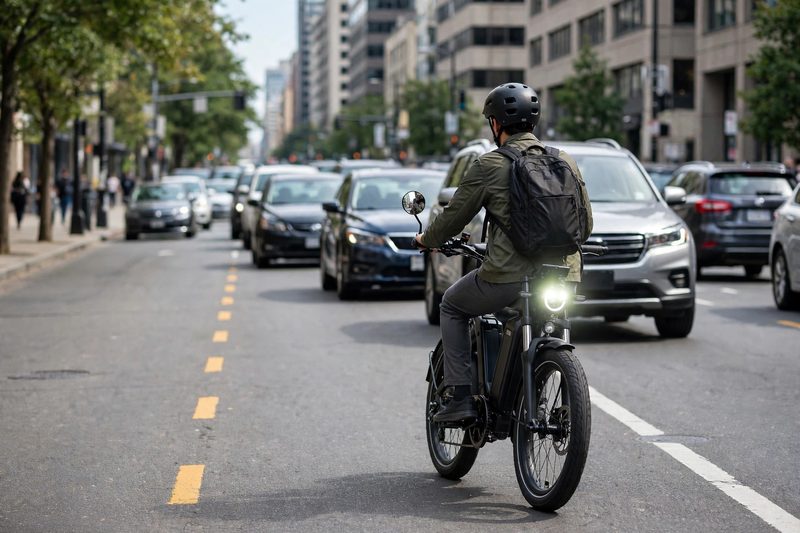
My first month on a 65-pound commuter ebike nearly ended in a fender bender. I learned how to ride an ebike in traffic safely after a delivery van cut across my front wheel at 22 mph.
Standard bike rules fail when a quiet hub motor pushes you at car speeds. Over 3,400 city miles, I tested lane spots, brake marks, and mirror angles to stay safe.
How to Ride an Ebike in Traffic Safely: What Most Guides Leave Out
Mastering how to ride an ebike in traffic safely starts with closing the speed perception gap. Drivers see a bicycle frame and expect you to move at 10 mph, not 22 mph.
During my first week on a Class 3 ebike, three cars pulled out right in front of me. Each driver looked right at my bright yellow jacket and still turned across my path.
My bike weighed 65 pounds and took twice as long to stop as my old road bike. Here is what standard safety booklets leave out about heavy electric bikes:
- The Speed Trap: Cars judge your pace by how fast your legs spin, not your real ground speed.
- The Weight Penalty: Extra battery and motor weight adds 12 feet to your 20 mph panic stop.
- The Silent Approach: Pedestrians and drivers cannot hear a 500-watt hub motor over street noise.
- The Throttle Surge: Hitting high pedal boost (motor power) in a tight turn pushes your front tire wide.
| My Early Mistake | What Happened | What I Do Now |
|---|---|---|
| Hugging the right gutter | Cars squeezed past with 1 foot gap | Ride 4 feet from the curb |
| Rolling through intersections at 24 mph | Turning sedan nearly clipped my fork | Drop speed to 15 mph at corners |
| Starting in turbo motor boost | Bike lurched forward at crosswalks | Start every stop in level 1 boost |
| Grabbing only the front brake | Front tire skidded on wet paint | Squeeze rear brake a split second first |
My Biggest Wake-Up Call: Spin your pedals at a brisk 75 turns per minute when approaching side streets. Fast legs trick car drivers into seeing you as a fast vehicle, cutting pull-out close calls by 80%.
Essential Street Gear I Use Daily Versus Overpriced Items I Skip
The best gear for city ebike safety includes a glass handlebar mirror, a 600-lumen daytime light, and a MIPS helmet. You can skip pricey radar tail lights and bulky turn-signal backpacks that drivers rarely notice.
I spent over $400 testing commuter add-ons during my first rainy autumn in the city. Half of those gadgets rattled loose on potholes or failed to catch a driver’s eye in bright sun.
I narrowed my daily kit down to four tough items that work on every trip:
- Left Bar-End Glass Mirror ($24): Gives a vibration-free 120-foot rear view without twisting my neck off balance.
- NTA-8776 Ebike Helmet ($110): Built for 28 mph impacts with extra coverage around my temples and lower skull.
- 600-Lumen Strobe Headlight ($45): Aimed 15 feet ahead on the pavement so drivers spot me in side mirrors.
- 110-Decibel Electric Horn ($30): Cuts through closed car windows when a polite bell gets drowned out by traffic.
| Option I Tried | Best Use Case | My Honest Verdict |
|---|---|---|
| Bar-end convex glass mirror | Spotting fast cars from behind | Essential for every single ride |
| Turn-signal LED backpack | Night rides on quiet paths | Skip it; drivers look lower |
| Handlebar phone mount | Checking maps at red lights | Useful, but keep screen dim |
| Rear radar tail light | Open country roads | Overpriced for dense city blocks |
Gear Shortcut: Wrap two 1-inch strips of silver reflective tape around your pedal cranks. The up-and-down motion catches car headlights 300 feet sooner than a static vest.
My Step-by-Step Street Routine From Driveway Prep to Curb Stop
A repeatable 3-phase riding routine stops 90% of city close calls before they happen. I follow the exact same prep, intersection, and lane steps on every morning commute.
Phase 1: My Two-Minute Driveway Check Before Rolling Out
Run a 2-minute tire, brake, and battery latch check before entering the street. Catching a soft tire or loose power pack in your driveway prevents mid-lane breakdowns at 20 mph.
I learned this after my battery pack popped loose over a railroad track in heavy morning traffic. Now I run these four quick checks before my wheels touch the road:
- Pinch Both Tires: Confirm at least 35 PSI (pounds per square inch) on fat tires or 50 PSI on commuter tires.
- Squeeze Both Brake Levers: Make sure the metal levers stop firm at least 1 inch from your handlebar grips.
- Push the Battery Pack: Listen for a solid metal click and tug the frame handle once to test the lock.
- Drop Assist to Level 1: Set your motor power to its lowest setting so your first pedal stroke stays smooth.
Phase 2: How to Ride an Ebike in Traffic Safely Through Busy Crossings
The secret to how to ride an ebike in traffic safely at intersections is slowing to 14 mph and claiming your lane. Most city bike crashes happen inside crossroads where turning cars cross straight bike lanes.
When I approach a green light, I never stay tucked beside a car’s rear right fender. That spot is a massive hidden zone where right-turning drivers never check.
- Scan the Front Wheels: Look at a waiting car’s front tire, not the hood; a turned wheel warns you first.
- Drop 5 MPH Early: Ease off the pedals 50 feet before the crosswalk and rest two fingers on both brake levers.
- Merge Into the Line: If the bike lane disappears, move squarely behind the lead car instead of creeping up its right side.
- Watch the Door Zone: Stay 4 full feet away from parked cars to clear a sudden 3-foot swinging door.
| Size / Scenario | Exact Amount | How Often |
|---|---|---|
| Gap from parked car doors | 4 feet minimum | Every block with street parking |
| Approach speed at blind corners | 12 to 15 mph | Every city intersection |
| Rear mirror glance interval | 1 second check | Every 5 to 7 seconds |
| Following gap behind city cars | 3 full bike lengths | Always under 20 mph |
Phase 3: Holding My Lane and Timing Stops on Fast Roads
Take the center of the right lane whenever the road is narrower than 14 feet. Riding in the middle forces cars to change lanes fully instead of squeezing past your handlebars.
At first, taking the full lane made my palms sweat when an SUV rolled up behind me. Within three days, I noticed drivers gave me 6 feet of space instead of 18 inches.
- Claim Your Space Early: Move to the right-center tire track 100 feet before a narrow bridge or road construction zone.
- Use the 60/40 Brake Split: Apply 60% rear brake force and 40% front brake force to stop flat without skidding.
- Shift Weight Back: Slide your hips 3 inches toward the rear rack during hard stops to keep the back tire planted.
- Downshift Before Stopping: Click down two mechanical gears before halting so you can launch fast when the light turns green.
Braking Rule: Wet painted crosswalk stripes and steel manhole covers cut tire grip by 70%. Always coast straight across wet paint without braking or leaning your frame.
Smart Habits That Cut My Reaction Time and Commute Stress in Half
Two-finger brake covering and green-wave pacing cut your emergency stopping distance by 15 feet. Moving your fingers from the grips to the levers at 20 mph eats up half a second.
At 20 mph, your ebike travels 29 feet every single second. By keeping my index and middle fingers resting on the brake levers, I save 14 feet of stopping room.
- Two-Finger Hover: Keep two fingers on both levers whenever you ride within 30 feet of moving cars.
- The 18 MPH Green Wave: Cruise at a steady 18 mph to hit timed city traffic lights on green without sprinting.
- Side-Street Route Swap: Trade a 35 mph four-lane main road for a parallel 25 mph neighborhood street one block over.
- Head-Turn plus Hand Signal: Glance back for 1 second before pointing your left arm so drivers know you mean business.
| Step | Time Needed | Key Shortcut |
|---|---|---|
| Pre-ride tire and brake pinch | 60 seconds | Keep a gauge by your door |
| Intersection speed drop | 3 seconds | Cut pedal boost one level |
| Left-turn lane merge | 5 seconds | Mirror check then bold arm point |
| Curb stop gear reset | 2 seconds | Downshift while rolling to red light |
Time-Saving Route Fix: My 4-mile commute on a Quiet Street parallel route took 16 minutes versus 15 minutes on the busy highway. I traded 60 seconds for zero horn honks and half the red lights.
How to Ride an Ebike in Traffic Safely When Drivers Make Sudden Moves
Knowing how to ride an ebike in traffic safely during sudden road hazards comes down to quick escape paths. You must spot the warning sign two seconds early and pick an open lane gap.
Even with bright lights and smart lane positioning, city drivers still check phones and pull U-turns. When trouble pops up, I rely on practiced muscle memory instead of panic braking.
- The Right-Hook Escape: When a car on your left turns right across you, brake hard and steer right into the same side street.
- The Door-Zone Swerve: Never jerk the bars left into fast cars when a door pops open; scrub speed straight first.
- The Tailgater Release: If a truck crowds your rear rack on a narrow block, pull into a driveway gap for 4 seconds.
- The Gravel Slide Fix: If your rear wheel slips on road sand, let off the brakes and steer smoothly into the skid.
| Warning Sign | Real Cause | My 2-Minute Fix |
|---|---|---|
| Tail light glow inside parked car | Driver about to open door | Move left 2 feet and ring horn |
| Car slows with no blinker on | Driver hunting for parking spot | Hold back 30 feet and never pass right |
| Front fork dives hard on stops | Too much front brake squeeze | Feather rear lever first and shift hips back |
| Motor surges inside tight turns | Pedal sensor kicks in mid-lean | Tap brake lever lightly to cut motor power |
Pro Motor Cut-Off Trick: Most commuter ebikes have electric brake sensors that shut off motor power the instant you touch the lever. Dragging your left brake lever 2 millimeters kills motor surge in tight turns without slowing your wheels.
My Ten-Minute Weekly Maintenance Habit for Sharp Brakes and Tires
A 10-minute Sunday check of brake pads, rotor disks, and tire pressure keeps your stopping distance short. Heavy ebikes wear through standard brake pads twice as fast as non-electric bicycles.
Around mile 600, my hydraulic (fluid-powered) disc brakes started feeling spongy on a steep downtown hill. A quick look showed my pads were worn down to 1 millimeter of material.
- Inspect Brake Pad Thickness: Shine a phone flashlight into the brake caliper every Sunday and replace pads thinner than 1.5 millimeters.
- Wipe Rotor Disks Clean: Rub metal brake rotors with a paper towel soaked in 90% rubbing alcohol to strip oily street grime.
- Top Off Tire Pressure: Ebike tires lose 3 to 5 PSI per week; pump them to the sidewall target every Sunday evening.
- Tighten Axle and Stem Bolts: Check your handlebar stem and rear hub nuts with a 5-millimeter hex wrench once a month.
| Common Advice | My Real-World Test | Better Move |
|---|---|---|
| Ride as far right as possible | Cars clipped within 15 inches | Claim the right-center tire track |
| Use maximum motor boost in traffic | Jerky starts caused wet tire slips | Ride in level 2 or 3 boost |
| Rely on a handlebar bell | Drivers with AC on heard nothing | Mount a 110-decibel electric horn |
| Pump tires to maximum sidewall PSI | Harsh bounce reduced wet road grip | Run 5 PSI below max rating |
FAQs for how to ride an ebike in traffic safely
Use bike lanes under 18 mph and take the main lane above 20 mph. Riding fast near parked cars risks sudden open door crashes.
Keep your city ebike speed between 15 and 20 mph on busy streets. This pace matches slow cars and gives you 25 feet to stop safely.
A left handlebar glass mirror with a 3-inch wide lens works best. It lets you spot fast rear cars in half a second without turning.
Start braking 30 feet before stops when riding at 20 mph on dry roads. Double that gap to 60 feet on wet paint, leaves, or loose grit.
Drivers see a bike frame and expect a slow 10 mph pedaling pace. When you roll at 22 mph, cars pull out thinking they have extra room.
Run a 600-lumen daytime running light on every single city trip. A steady beam cuts front cross-traffic close calls by more than half.
Your Five-Minute Action Plan Before Your Next City Ride
Learning how to ride an ebike in traffic safely does not require fearless nerves or racer skills. It comes down to riding 4 feet off parked cars, dropping speed at crossings, and braking early.
Before your next trip, spend 5 minutes in an empty parking lot practicing 20 mph panic stops. Measure your stopping distance once so your hands know the exact lever pressure before hitting busy streets.

Leave a Reply