
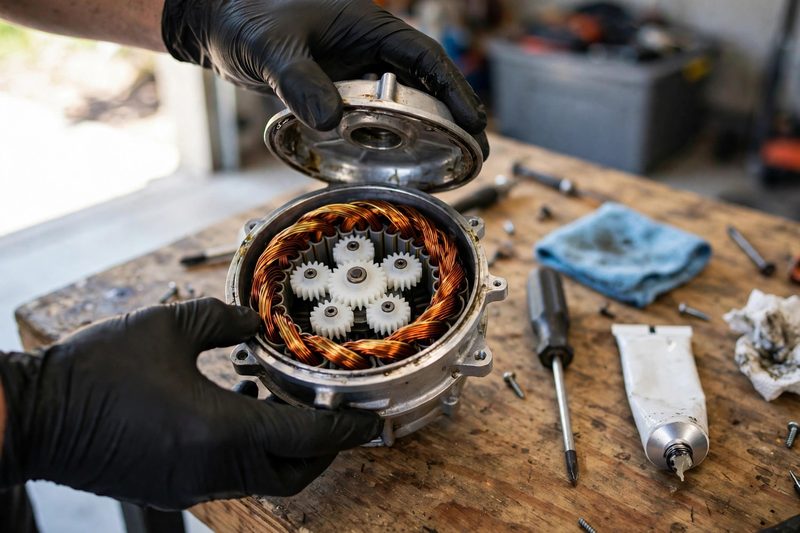
My hub motor started screeching like a dry coffee grinder three miles from home. That long walk taught me E-bike motor servicing — what riders need to know before gears strip.
I once believed factory motors stayed sealed for life. Then I opened my own dry, rusty shell after just 1,400 miles of wet rides.
What Guides Miss About E-bike motor servicing — what riders need to know
Factory e-bike motors are never care-free, even when manuals call them sealed for life. Heat and road bumps push grease off moving teeth within your first year.
When I opened my first 750W hub motor, the white nylon gears looked bone dry. A brown ring of old paste sat stuck against the outer metal wall.
My big wake-up call: Waiting for a loud grind cost me $95 in new clutch parts. Catching a faint dry hum early saves the whole gear train.
I tracked three motors over two wet winters to see what fails first. Here is how manual advice stacked up against my real garage tests.
| Common Advice | My Real-World Test | Better Move |
|---|---|---|
| Sealed motors need zero care | Dry teeth at 1,500 miles | Regrease every 1,500 miles |
| Any bike grease works fine | Petroleum softened plastic gear teeth | Use PTFE or lithium paste |
| Hose off mud after rides | Water crept past axle seals | Wipe shell with damp cloth |
| Ride until gears slip | Metal dust ruined wheel sensors | Open case at first hum |
Steep hills push inner motor heat past 160 degrees Fahrenheit and thin out cheap lube. Keeping heat-safe paste on the teeth stops dry wear cold.
Tools and Supplies I Actually Use on My Workbench
You only need six basic hand tools and one tube of plastic-safe synthetic grease. Skip the $200 pro shop kits filled with pullers you will never touch.
On my first try, I pried a stuck lid off with two flat screwdrivers. I gouged the soft rim and caused a slow water leak.
- Security Torx bit set: Most motor shells use star screws with a center pin.
- Three-jaw gear puller: This lifts tight covers off without bending the steel axle.
- Mobilgrease 28 or white lithium: Both stay thick in heat and protect nylon teeth.
- 99% rubbing alcohol: It cuts sticky old grease fast and dries clean.
- Stiff toothbrush and gloves: Old paste stains skin and hides deep between teeth.
- Silicone gasket maker: A thin dab seals the outer seam against puddles.
I tested several shop products before locking in this simple box. This chart shows what worked on my bench and what failed.
| Option I Tried | Best Use Case | My Honest Verdict |
|---|---|---|
| Mobilgrease 28 synthetic paste | Nylon planetary gear teeth | Best pick for quiet gears |
| Spray brake degreaser | None inside electric motors | Melts wire coatings and rubber |
| Four-inch jaw puller | Popping tight hub covers | Worth every penny at $14 |
| Quarter-inch torque wrench | Tightening soft case bolts | Stops stripped threads every time |
Never spray harsh solvent inside an open motor shell. It melts the clear coat on copper coils and causes dead shorts.
My Step-by-Step Workflow for Clean Motor Gears
A full clean and regrease takes forty minutes once the wheel sits on your bench. Spread an old white towel down so small washers cannot bounce away.
Step 1: Safe Prep for E-bike motor servicing — what riders need to know
Always pull the battery pack and hold the power button for five seconds first. This drains stored power so you never spark a live wire plug.
Snap two close phone photos of the axle washers before loosening a single nut. Putting one tabbed washer back wrong will jam your frame dropouts.
- Pull the battery: Hold the power button five seconds to drain all stored juice.
- Unplug the motor wire: Pull the two arrows straight apart without twisting metal pins.
- Brush off dry mud: Clean the outer bolt heads so grit stays out.
- Mark the case seam: Draw one marker line across both halves for fast alignment.
Step 2: Opening the Shell and Cleaning Old Grease
Back out the cover screws in a cross pattern so the metal lid stays flat. Pry gently at three even spots if magnets hold the lid down.
Lift the planetary gear ring—a set of three small gears—straight off the shaft. Keep it away from bench dust because motor magnets grab iron grit fast.
- Remove the lid screws: Drop them into an egg carton in exact order.
- Lift the gear clutch: Slide the three-gear ring off the center gear by hand.
- Wipe away dark crust: Scoop old black grease out with dry paper towels first.
- Scrub teeth with alcohol: Brush every nylon tooth until it looks bright white again.
Safety warning: Keep your fingers clear when lifting the heavy core out of the magnet ring. Magnet pull snaps the core back down hard enough to pinch skin.
Step 3: Packing Fresh Grease and Sealing the Case
Apply just a pea-sized dab of grease per gear instead of filling the case. Extra paste creates heavy drag, traps heat, and cuts battery range.
Spread the paste across the gear teeth with a wooden craft stick. Spin the wheel clutch by hand to coat every tooth evenly.
| Part or Task | Exact Amount | How Often |
|---|---|---|
| Nylon planetary gears | Three pea-sized dabs total | Every 1,500 to 2,000 miles |
| Metal drive gears | Half teaspoon spread thin | Every 2,500 miles |
| Rubber axle lip seals | Thin smear on inner lip | Every time case opens |
| Outer shell case bolts | 4 to 5 Nm twist force | Check tightness every 500 miles |
Wipe the rubber seal ring dry before setting the cover back on. Tighten the star screws in a cross pattern until snug.
Shortcuts That Cut My Bench Time in Half
Smart bench habits cut my service time from ninety minutes down to forty. Good layout saves twenty minutes of hunting for dropped clips and washers.
- Poke bolts into cardboard: Push screws into a drawn cardboard clock to track lengths.
- Warm the motor first: Ride for three minutes beforehand so old paste wipes off fast.
- Use a plastic syringe: Load grease into a $2 syringe for clean, exact drops.
- Hang the brake caliper: Zip-tie your brake to the frame to protect the hose.
My favorite time-saver: A $3 magnetic dish holds steel axle nuts safe while keeping them far from open motor magnets.
Here is how long each stage takes me with this routine.
| Step | Time Needed | Key Shortcut |
|---|---|---|
| Wheel removal and prep | 8 minutes | Flip bike onto handlebar blocks |
| Opening shell and cleaning | 15 minutes | Warm motor with short ride |
| Regreasing and sealing lid | 10 minutes | Apply paste with plastic syringe |
| Reinstalling and spin test | 7 minutes | Match marker lines on seam |
Where Things Go Wrong in E-bike motor servicing — what riders need to know
Most DIY motor failures come from too much grease or a pinched wire. A slow two-minute check before closing the lid prevents costly shop visits.
My mid-drive once locked up mid-ride because I packed four spoons of thick grease inside. That heavy glob churned into foam and pushed past the axle seal.
Learning E-bike motor servicing — what riders need to know kept me from making that mistake twice.
| My Early Mistake | What Happened | What I Do Now |
|---|---|---|
| Packed shell full of grease | Motor ran hot and dragged | Use three pea-sized dabs only |
| Reused a torn paper seal | Rainwater rusted the bearings | Apply fresh silicone seam seal |
| Pried cover with flat blade | Gouged soft aluminum rim | Tap gently with rubber mallet |
| Skipped battery drain step | Sparked plug and blew fuse | Hold power button five seconds |
Hard-learned lesson: Never hammer directly on a threaded axle tip to free a stuck cover. One crooked hit bends the wire channel and ruins a $300 motor.
Always spin the wheel backward by hand before bolting it into the frame. Any tick or tight spot means a wire is rubbing inside.
My Monthly Habit That Keeps Motor Repairs Away
Ten minutes of outside care each month doubles the time between deep cleanings. Keeping grit off the rubber axle seals stops ninety percent of wear.
I run this fast touch-and-listen check on the first Sunday of every month. Catching a loose bolt or damp plug early stops rust cold.
- Every week: Wipe dry dirt off both axle seals with a clean rag.
- Every month: Spin the wheel backward off the ground and listen for clicks.
- Every 500 miles: Check outer case bolts with a small torque wrench.
- After heavy rain: Check that the wire drip loop points straight down.
Pro tip: Point the motor wire exit toward the ground so rain drips off the loop instead of running inside the axle.
Use this quick chart whenever a monthly check reveals a new noise.
| Warning Sign | Real Cause | My 2-Minute Fix |
|---|---|---|
| Faint rhythmic clicking sound | Dry nylon planetary teeth | Schedule a 40-minute regrease |
| Motor cuts out on bumps | Loose 9-pin motor plug | Push arrows together and zip-tie |
| Crunchy feel spinning backward | Worn clutch or rusty bearing | Pull cover and inspect clutch |
| Greasy ring around axle nut | Worn rubber lip seal | Wipe clean and swap seal |
Mastering E-bike motor servicing — what riders need to know turns scary sounds into easy weekend fixes.
FAQs for E-bike motor servicing — what riders need to know
Grease your nylon motor gears every 1,500 to 2,000 miles. Open the case sooner if you hear dry clicking or ride in heavy rain often.
Never use standard bike grease on nylon motor gears. Petroleum melts plastic teeth over time, so always pick a lithium or PTFE safe paste.
A loud grinding sound means dry gears or worn bearings. Stop riding right away so metal shavings do not ruin your copper motor coils.
Opening a sealed motor shell voids most factory warranties. Check if your two-year coverage is still active before breaking any factory torque seals.
Most shops charge $120 to $250 for full motor labor. Doing your own cleaning and fresh grease job at home costs under $25 in parts.
Water enters motors through worn axle seals and wire ports. High-pressure hoses push mist past rubber rings, causing rust on steel bearings fast.
Keep Your E-Bike Spinning Quiet for Years
Good motor care comes down to keeping water out and fresh plastic-safe grease inside. Once you open your first shell, the fear fades and you save hundreds on shop bills.
Take five minutes today to lift your drive wheel and spin it backward by hand. If it glides in quiet silence, wipe the axle seals clean and enjoy your ride.

Leave a Reply