
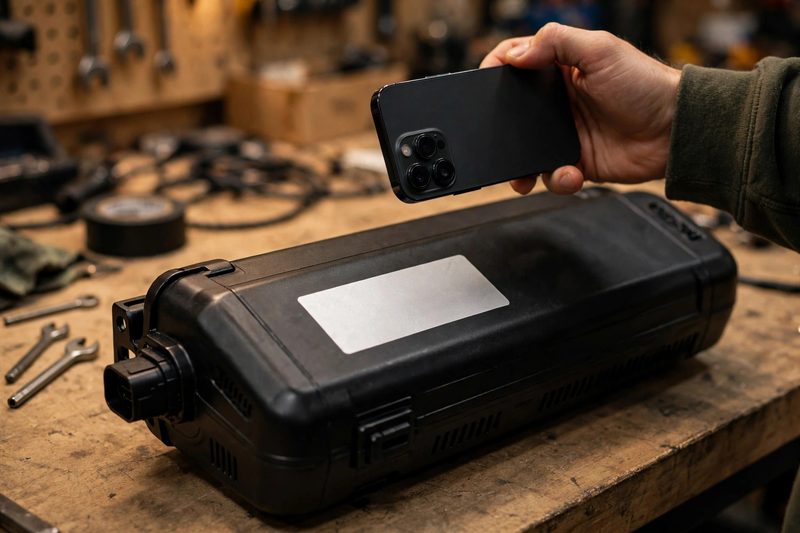
Three years ago, I sparked a loud garage fire hazard on my workbench. Having my ebike battery label explained back then would have saved me $420. Instead, I plugged a 58.8V charger into a 48V Hailong commuter pack.
Acrid white smoke poured out of the melted rubber charge port in seconds. That tiny silver sticker held every rule my pack needed to stay safe. Today, I check every code before any battery touches my bike frame.
Why Having My ebike battery label explained Saved My Garage
Your battery sticker is a safety map that stops fires and dead rides. It tells you the exact speed, range, and charger limits for your cells.
When I pried open my charred plastic case, the problem was obvious. The battery management board had blown two tiny black fuses near the wire harness. I had ignored the max charge rating printed two inches from the plug.
At first, the mix of letters, slashes, and numbers looked like secret code. Once I linked each symbol to how my bike rode, the mystery vanished. You only need plain grade-school math to read any pack like a pro.
My Garage Lesson: Never trust a random charger brick pulled from a parts bin. Always match your charger volts to the max limit on your pack label.
The Big Three Numbers on Every Pack Sticker
Volts, amp-hours, and watt-hours control how fast and how far you ride. Think of your battery pack like a pressurized garden hose in your yard.
Nominal Voltage (V): This is water pressure pushing power into your motor hub. A 48V pack climbs steep hills faster than a 36V pack.
Amp-Hours (Ah): This measures how wide your fuel tank is at a set voltage. My 14Ah pack lasts much longer than my old 10Ah backup pack.
Watt-Hours (Wh): This is your true total fuel when you multiply volts by amp-hours. I divide watt-hours by 20 to guess my real miles on flat pavement.
Continuous Discharge (A): This shows how wide the nozzle opens without overheating the wires. A 30A rating feeds power-hungry 750W motors without cutting out on climbs.
Decoding Cell Codes Like 13S4P and INR18650
Cell codes reveal how many lithium tubes sit inside your plastic shell. They also show the exact chemistry and size of each metal cylinder.
When I stripped my first Hailong case, I counted 52 pink metal tubes. They sat in neat plastic honeycomb holders linked by shiny nickel strips. The label read 13S4P, which matched my hand count on the bench.
13S (Series): Thirteen cell groups wired end to end add up to 48 volts. Each lithium cell brings 3.6V to 3.7V of nominal push to the stack.
4P (Parallel): Four cells wired side by side quadruple the amp-hour capacity. Four 3.5Ah cells in parallel give your pack a 14Ah total rating.
INR / ICR Letters: These letters name the metal mix inside each cell tube. INR uses nickel and manganese, which stays cooler under heavy hill loads.
18650 vs. 21700 Numbers: An 18650 cell is 18 millimeters wide and 65 millimeters long. Newer 21700 cells are thicker and pack more range into smaller frames.
I tested four common cell types across three riding seasons in wet heat. Here is how those sticker codes performed on my daily commute.
| Option I Tried | Best Use Case | My Honest Verdict |
|---|---|---|
| INR18650 (Samsung 35E) | Daily city commuting | Great range, stays cool |
| INR21700 (LG M50LT) | Heavy cargo hauling | Dense power, heavier case |
| LiFePO4 (3.2V Cells) | Long 5-year lifespan | Super safe, very bulky |
| Unbranded Generic 18650 | Short flat errands | High voltage sag on hills |
How Your ebike battery label explained Works on Real Roads
Sticker numbers shift every minute as you ride up hills or hit wind. A label shows lab averages, not what happens at full throttle in winter.
Your sticker lists 48V, but a fresh pack never reads 48V on a meter. When I pull my pack off the charger, my Fluke 117 multimeter reads 54.6V. By the time my handlebar display flashes empty, the pack sits near 39V.
Cold mornings also shrink the amp-hour number printed on your plastic shell. At 40°F, thick liquid inside the cells slows down the chemical flow. I lose four miles of range every winter even though my sticker says 672Wh.
Matching Charge Volts and Max Amps Without Sparks
Your charge limit and discharge rating protect the internal circuit board from melting. Exceeding either number trips the safety switch or welds your plug shut.
Max Charge Voltage: A 36V pack peaks at 42V, while a 48V pack peaks at 54.6V. A 52V pack peaks at 58.8V when every cell hits 4.2V full.
Max Charge Current: Most labels cap charging between 2 amps and 4 amps. Pushing 5 amps into a 2A port melted my plastic socket fast.
BMS Cutoff Rating: The battery management system (BMS) shuts power off during short circuits. My 25A controller cut out on hills until I bought a 30A pack.
Connector Type Limits: Barrel jacks handle 2A to 3A safely during overnight wall charging. For 4A fast charging, I swap in beefy XT60 or XLR plugs.
My Thermometer Check: I point an infrared laser thermometer at my charge port after one hour. If the plug tops 115°F, I unplug it and clean the brass pins.
Ebike Battery Label Explained: Safe Operating Limits I Measure
Staying inside voltage and heat limits doubles how many years your pack lasts. I taped these exact targets above my charging shelf for quick checks.
| Size / Scenario | Exact Amount | How Often |
|---|---|---|
| 48V Full Charge Peak | 54.6 Volts max | Every full balance charge |
| 48V Low Cutoff Limit | 39.0 Volts min | Never drop below this |
| Safe Charging Temp | 50°F to 77°F room | Every single plug-in session |
| Winter Storage Charge | 47.5V to 48.5V level | Check once every 30 days |
| Standard Charge Current | 2 Amps to 3 Amps | Daily overnight top-ups |
Common Sticker Myths vs. My Workbench Test Results
Many cheap online battery stickers print fake numbers that break basic physics. I verify bold range claims with a kitchen scale and a watt meter.
Online sellers love slapping gold foil labels onto blue shrink-wrapped battery bricks. They claim massive capacity inside a tiny frame bag that costs eighty bucks. My bench load tester proved those stickers lie by fifty percent or more.
| Common Advice | My Real-World Test | Better Move |
|---|---|---|
| More Ah fits any size | 100Ah labels held 8Ah | Weigh pack on kitchen scale |
| CE mark proves fire safety | Fake stamps wash off fast | Demand UL 2271 lab code |
| Drain to zero monthly | Killed two cell groups | Recharge at 30 percent left |
| Any 3-pin plug works | Reversed pins sparked hard | Check pin polarity with meter |
Why My First ebike battery label explained Test Exposed a Fake Pack
A real lithium cell has a fixed weight that scammers cannot fake. Checking my ebike battery label explained math on a scale caught a fake.
Last spring, a neighbor brought me a bargain 48V pack labeled at 60Ah. It felt suspiciously light when I lifted it onto my wooden workbench. My digital scale read 5.4 pounds, including the heavy aluminum mounting rail.
A real 48V 60Ah pack requires over 150 cells and weighs thirty pounds. When I peeled back the sticker, half the plastic slots held bags of sand. My inline watt meter showed the pack held just 7.2 amp-hours total.
The 7-Pound Rule: A true 48V 14Ah battery pack always weighs between 7 and 8.5 pounds. If a high-capacity pack feels like a hollow lunchbox, send it right back.
Misreading or trusting bad labels caused me plenty of headaches in my first year. Here are the rookie errors I fixed on my own bikes.
| My Early Mistake | What Happened | What I Do Now |
|---|---|---|
| Ignored BMS amp limit | Pack shut off uphill | Match BMS to controller amps |
| Charged cold pack at 35°F | Lost 20 percent range | Warm pack indoors 2 hours |
| Skipped date code check | Bought 3-year-old dead stock | Reject packs over 6 months |
| Washed label with hose | Ink vanished in one week | Cover label with clear tape |
When Decoding Battery Codes Matters (And When to Skip It)
You need label skills whenever you swap chargers, buy used, or build kits. If you ride a warrantied shop bike with stock gear, you can relax.
My sister rides a stock Bosch commuter bike serviced by our local bike shop. She only checks the green charge bars and stores the pack inside her hallway.
For riders like her, deep cell math is not needed on weeknights.
Three Riders Who Must Check Every Single Symbol
DIY builders, used bike shoppers, and apartment renters face the highest battery risks. One bad match can void your lease or fry a motor kit.
Used Bike Buyers: Sellers often pair a worn bike with a random cheap charger brick. I inspect both labels before handing over cash in a parking lot.
DIY Mid-Drive Builders: Bafang 750W and 1000W motors pull heavy amps on steep dirt trails. You must verify a 30A continuous rating on the pack label.
Apartment Commuters: Many landlords and cities now ban uncertified packs inside shared hallways. You need a genuine UL 2271 stamp printed right on the shell.
Touring Riders: Packing two batteries requires identical voltage ratings so one controller works safely. Mixing a 52V spare with a 48V display scrambles your battery meter.
Warning Signs That Mean Your Sticker No Longer Matches Reality
Lithium cells age every month and lose capacity regardless of what the label says. Watch for physical clues that show your pack has drifted off spec.
After 500 charge cycles, my favorite 14Ah pack only held 11Ah on my meter. Heat, road vibration, and age build internal resistance inside the metal cans. When your bike acts up, use my two-minute bench table to spot the culprit.
| Warning Sign | Real Cause | My 2-Minute Fix |
|---|---|---|
| Full charge stops at 52V | Unbalanced cell group inside | Leave on charger 4 hours |
| Bars drop fast on hills | High internal cell resistance | Drop pedal assist down two |
| Charger light flashes red | Blown charge port fuse | Swap 5A fuse inside case |
| Sweet chemical smell | Leaking punctured cell pouch | Move pack outside to sand |
Safety Stamp Tip: Real UL 2271 labels include a unique file code starting with the letter E. I verify that code on the UL Product iQ site in seconds.
My 3-Step Starter Plan to Read Any Pack Label Today
You need three simple checks to decode any ebike pack in two minutes. Skip the tiny serial barcodes at first and focus on power and safety.
Once you have your ebike battery label explained step by step, checking takes seconds. I run through this exact sequence whenever a friend brings a bike over. Grab your smartphone and a roll of painter’s tape to get started.
Snap a Macro Phone Photo: Turn your battery upside down under bright kitchen light. Take a clear photo so you can zoom in on tiny fonts.
Run the Watt-Hour Math Check: Multiply the nominal volts by the amp-hours on your phone calculator. If the printed Wh number differs, the label is fake.
Match the Charger Output Label: Flip your charger brick over and read the DC output line. Confirm the charger volts match the max charge limit on your pack.
My 5-Minute Bench Check Before Every First Charge
I run this exact five-minute routine whenever a new battery hits my workbench. It catches shipping damage, bad chargers, and fake stickers before I plug in.
| Step | Time Needed | Key Shortcut |
|---|---|---|
| 1. Tape the thermal label | 1 minute | Use 2-inch clear packing tape |
| 2. Weigh on kitchen scale | 1 minute | Expect 0.5 lbs per 100Wh |
| 3. Probe terminal volts | 2 minutes | Set multimeter to 200V DC |
| 4. Label the charger brick | 1 minute | Write voltage on blue tape |
My Best Tape Trick: Thermal printer ink fades fast when frame grime or sun hits the battery case. Stick a strip of clear packing tape over the label on day one.
FAQs for ebike battery label explained
13S4P means 13 cells sit in series and 4 sit in parallel. Series sets your 48V push, while parallel boosts total miles per charge.
Multiply your nominal volts by the amp-hour rating on the sticker. A 48V pack rated at 14Ah holds 672 watt-hours of real energy.
Yes, a 48V lithium pack needs a 54.6V charger to reach full capacity. Never exceed the max charge voltage printed on your pack label.
Look for the UL 2271 stamp on your battery case before buying. This mark proves a real lab tested the pack against fire and water.
Weigh the battery pack on a kitchen scale right out of the box. A real 48V 20Ah pack weighs around 10 to 12 pounds on my workbench.
Check the serial barcode on the bottom plate for a 4-digit date stamp. A code like 2510 means the factory built it in week 10 of 2025.
What Checking My Battery Sticker Taught Me After 4,000 Miles
Reading your battery sticker takes two minutes and prevents costly garage fires. You do not need fancy shop gear to spot fake capacity claims or wrong chargers.
Walk out to your bike right now and snap a clear photo of your pack label. Wrap a piece of painter’s tape around your charger cord and write the exact voltage on it today.

Leave a Reply