
TL;DR
- Lube an ebike chain every 100-150 miles in normal dry riding, and sooner when conditions are bad (Engwe, accessed 2026).
- Lube again after every ride in the rain (NFPT, 2025).
- In mud, dust, or off-road riding, reapply every 30-75 miles (Engwe, accessed 2026).
- Squeaking, rough pedaling, and sloppy shifting mean the chain is already overdue.
- Clean the chain before lubing. New lube over old grime speeds up wear.
How Often Should You Lube an Ebike Chain?
Lube your ebike chain every 100-150 miles in dry conditions, after each wet ride, and every 30-75 miles in mud, dust, or off-road terrain. Mileage is a better trigger than calendar days, because a rider who commutes daily wears a chain faster than a weekend rider.
Different sources give slightly different numbers. BikeRadar (accessed 2026) calls 100 miles of fine-weather road riding adequate. NFPT (2025) recommends every 100 miles plus after wet rides. A cycling retailer, Mr Cycling World (accessed 2026), suggests 150-250 km (roughly 93-155 miles) in dry conditions. All three agree on the basic rhythm: roughly every 100 miles, with extra applications when the weather turns.
If you want a single rule, use 100 miles as your default and shorten the interval as conditions get worse.
Ebike Chain Lube Schedule by Riding Conditions
Your riding environment sets the interval more than any other factor. One ebike retailer, Leoguar (accessed 2026), calls the riding environment the most important factor in deciding lube frequency. The table below turns the published ranges into a working schedule.
| Riding Condition | Lube Interval | Source |
|---|---|---|
| Dry, paved roads | Every 100-150 miles | Engwe (accessed 2026) |
| Wet weather | After every wet ride | NFPT (2025) |
| Rain, dust, or off-road | Every 30-75 miles | Engwe (accessed 2026) |
| Dry lube in any conditions | Often every 100 miles or less | Leoguar (accessed 2026) |
| Heavy weekly use | Weekly, or every 100-200 miles | GreenMoov (accessed 2026) |
Chain guards matter too. Upway (accessed 2026) notes that a closed chain guard makes maintenance easier, while an exposed drivetrain needs attention more often.
Why Ebike Chains Are Lubed by Mileage Instead of Calendar Time
Mileage tracks how much work the chain has done, so it predicts wear better than elapsed time. Leoguar (accessed 2026) points out that motor assistance lets riders go further and more often, which raises mileage and speeds up drivetrain wear.
Think of chain lube like engine oil in a car. A car that sits in a garage for a month needs nothing, while one that drives 3,000 miles needs service. A chain follows the same logic.
Torque adds to this. Ebike motors push more force through the chain than a rider’s legs alone, and lube is the thin layer that keeps metal parts from grinding against each other under that load.
Signs Your Ebike Chain Needs Lube Right Now
If the chain squeaks, feels rough under pedaling, shifts poorly, or looks dry or rusty, lube it immediately. Engwe (accessed 2026) lists exactly these symptoms and says to act at once on high-torque bikes.
Do not wait for the noise. One rider on the Mountain Bike Reviews forum (accessed 2026) argued that waiting for a creak is too late on an ebike because of the torque loads. Treat noise as a late warning, and use your mileage interval as the real trigger.
A quick visual check helps between services. A chain that looks shiny and slightly wet is fine. A chain that looks gray, dull, or orange is dry.
Wet Lube vs Dry Lube: How the Type Changes Your Schedule
Dry lube needs reapplying more often than wet lube. Dry lube runs clean in dusty conditions but washes off easily in rain, so Leoguar (accessed 2026) says it often needs reapplying every 100 miles or less.
Wet lube clings to the chain and lasts longer in rain, but it attracts more dirt. Evo (accessed 2026) advises checking the instructions on your lube bottle, since staying power varies between products.
Ceramic lubes are a third option. They cost more but reduce friction and last longer, per Letrigo (accessed 2026), which makes them a fit for high-mileage riders.
Match the lube to your weather, then set your interval from the bottle’s guidance and the table above.
How to Lube an Ebike Chain Without Making It Worse
Clean the chain first, apply lube while the chain turns, let it sit, then wipe off the excess. Engwe (accessed 2026) warns never to apply lube over dirt, mud, or old grime, because it traps debris and speeds up wear.
Here is the process:
- Wipe the chain with a rag and degreaser until it is clean and dry.
- Put the bike on a workstand and turn the pedals backward so the chain moves.
- Apply one drop of lube to each roller as the chain rotates.
- Let the lube set for a few minutes (Letrigo, accessed 2026).
- Wipe the outside of the chain with a clean cloth to remove excess.
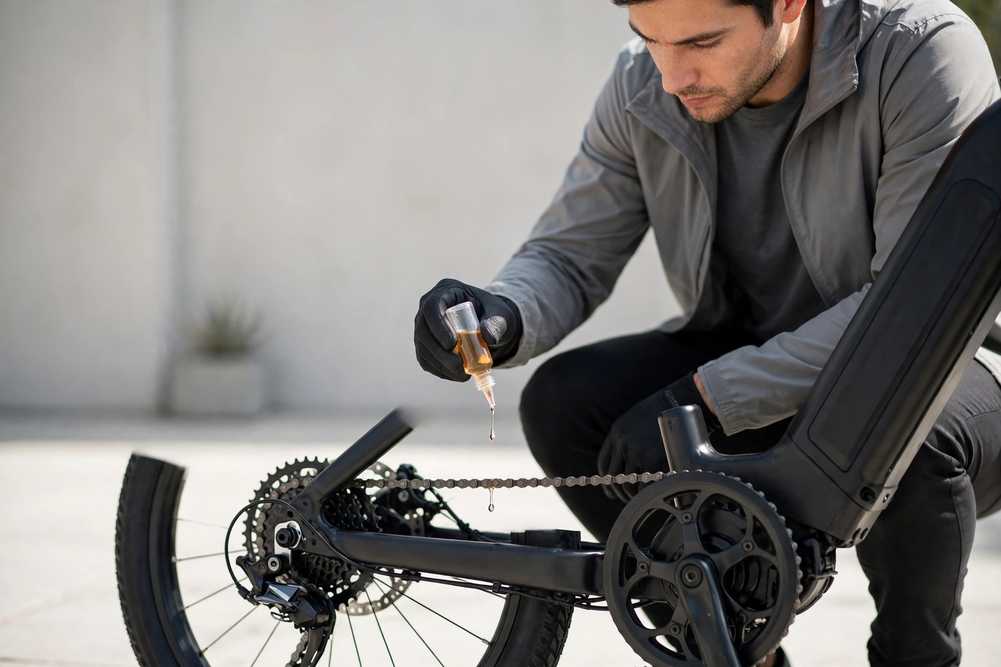
Step 2 deserves a note. On many ebikes the cranks spin freely without moving the rest of the drivetrain, so BikeRadar (accessed 2026) suggests a workstand or a crank tool such as the Muc-Off ebike drivetrain tool.
Common Ebike Chain Lubing Mistakes
The most frequent mistakes are using the wrong product, lubing a dirty chain, and skipping wear checks. Each one shortens chain life even when you lube on schedule.
- Using WD-40 as chain lube fails because it is a cleaner and water displacer that evaporates quickly, according to Engwe (accessed 2026).
- Adding more lube than needed leaves a sticky surface that collects grit.
- Ignoring wear lets a stretched chain damage the cassette. GreenMoov (accessed 2026) recommends checking wear every 500-750 miles with a chain checker and replacing the chain at 0.5% wear on ebikes.
Lube extends chain life but does not make it permanent. Wear checks tell you when to replace it.
Frequently Asked Questions About Lubing an Ebike Chain
Lube it every 100-150 miles in dry conditions and after every wet ride. In mud, dust, or off-road riding, shorten that to every 30-75 miles.
Listen and look. Squeaking, rough pedaling, poor shifting, or a dry, rusty appearance all mean it needs lube now.
Yes, if it suits your conditions. Leoguar (accessed 2026) says a quality lube matched to your riding conditions matters more than an “ebike-specific” label, though some retailers prefer ebike-rated products for the extra load.
No. It cleans and displaces water but evaporates quickly and leaves the chain unprotected under motor torque (Engwe, accessed 2026).
Yes. Lube applied over dirt or old grime traps debris and speeds up wear, so wipe and degrease the chain first.
Every 500-750 miles, using a drop-in chain checker such as the Park Tool CC-4.2 (GreenMoov, accessed 2026).
References
- BikeRadar, “How to lubricate your bike chain in three easy steps”: https://www.bikeradar.com/advice/workshop/how-to-lubricate-your-bike-chain
- Levy Electric, “Maintaining Your Electric Bike: Chain Lubrication Frequency Guide”: https://www.levyelectric.com/resources/maintaining-your-electric-bike-chain-lubrication-frequency-guide
- Rad Power Bikes, “How to Clean and Lubricate Your Bike Chain”: https://blog.radpowerbikes.com/blogs/the-scenic-route/how-to-clean-and-lubricate-your-bike-chain

Leave a Reply