
TL;DR
- To store an ebike in winter, remove the battery, charge it to roughly 30-60%, and keep it indoors in a dry room at room temperature.
- Bosch recommends a 30-60% charge, room temperature, and a dry room away from flammable materials (Bosch eBike Systems, 2026).
- Wash and dry the bike, lube the chain, and inflate the tires to the pressure printed on the sidewall.
- Check the battery every 4 weeks and top it up if the charge has dropped.
- Allow about an hour for the full prep.
What Happens to an Ebike Battery During Winter Storage?
An ebike battery loses charge while idle, and cold weather makes it worse. A battery discharges even when unused, and sudden temperature swings can permanently damage lithium-ion cells (Cycling UK, 2026).
Charge level matters too. Bosch lists prolonged storage at full or empty charge, and storage above 30 °C, as factors that shorten battery life (Bosch eBike Battery Guide, 2020).
Think of the battery like a spring. Wound all the way or left completely slack, it wears faster than when it rests at a middle tension.
What You Need Before You Start
You need very little. Gather these before step 1:
- A bucket, sponge, and dry towels
- Chain lube and a clean rag
- A floor pump with a gauge
- A dry indoor spot for the battery, such as a closet or spare room
- A bike cover that breathes (optional)
Step 1: Wash and Dry the Ebike
Wash the bike before storage, because road salt and grime corrode the frame, chain, and gears over a long idle period. Use a sponge and gentle cleaner, then dry everything with a towel.
Skip the pressure washer. Aventon states its ebikes are IPX4 water-resistant, so a bucket and sponge are fine but pressurized water is not (Aventon, 2026). Electric Bike Report also warns against spraying the motor or other electronics (Electric Bike Report, 2026).
Step 2: Clean and Lube the Chain
Lubing the chain stops rust while the bike sits. Apply one small drop of lube to each link, then wipe off the excess so the chain does not attract dirt (WildSyde, 2026).
Turn the pedals backward as you apply the lube so it spreads evenly. Keep oil away from disc brake rotors. Eurobike warns that oil on brake discs is a problem (Eurobike, 2026).
Step 3: Remove the Battery and Display
Take the battery off the bike and store it indoors. Eurobike advises storing the battery and bike computer separately from the bike in winter because the battery is sensitive to extreme temperatures (Eurobike, 2026).
The bike itself can stay in a garage or shed. The battery should not.
Step 4: Set the Battery Charge Level for Storage
Charge the battery to about 30-60% before storing it. That is two to three bars on most LED indicators. Tern’s Bosch battery guide gives this range and says prolonged storage at full or empty charge can shorten battery lifespan (Tern Bicycles, 2026).
Brands differ on the exact range. Some manufacturers suggest 40-60% or 50-80%, so check your manual first. A mid-level charge is the safest choice if you have no other guidance.
Do not leave the battery plugged in all winter. Bosch says to charge only in a dry area fitted with a working smoke detector (Bosch eBike Systems, 2026).
Step 5: Store the Battery at Room Temperature

Keep the battery in a dry room around 20 °C (68 °F). Tern’s guide gives about 20 °C as the best storage temperature and says to avoid anything below 0 °C or above 40 °C (Tern Bicycles, 2026).
Choose a spot away from radiators, direct sun, and flammable items. Bosch specifically says not to store the battery near combustible or flammable objects (Bosch eBike Systems, 2026).
Step 6: Inflate the Tires and Pick a Storage Spot
Inflate both tires to the pressure printed on the sidewall. Low pressure during storage can damage rims, tubes, and tires, and the sidewall shows the maximum safe pressure (Eurobike, 2026).
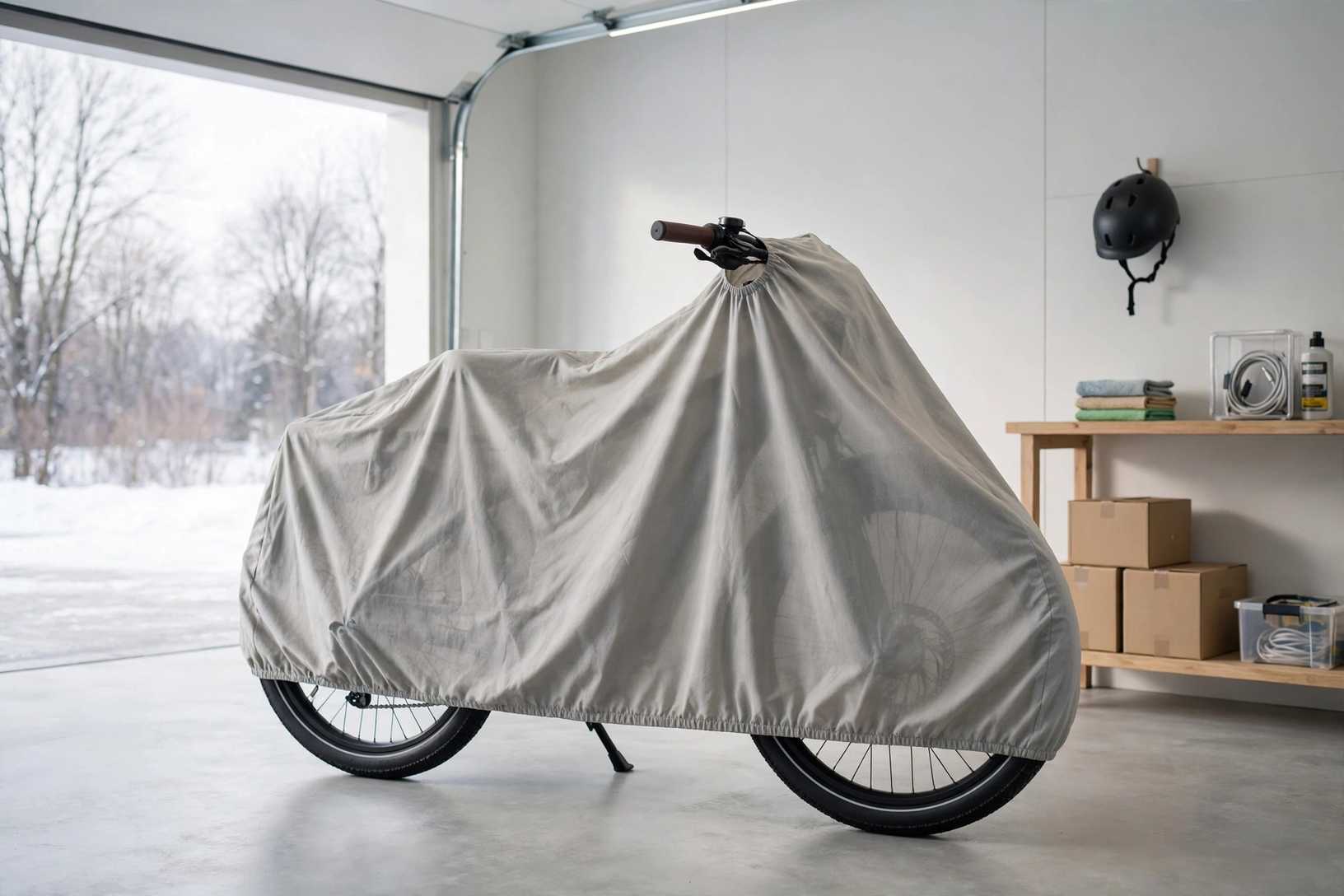
Store the bike in a dry place and add a breathable cover if dust or moisture is a concern. An upright bike is fine as long as the tires stay inflated, though hanging saves space (Eurobike, 2026).
Step 7: Check the Battery Every Month
Check the battery about once a month and recharge it if the level has dropped. Tern recommends topping a stored Bosch battery back up to 30-60% when needed and suggests setting calendar reminders (Tern Bicycles, 2026).
During the same check, look at tire pressure and scan the frame and chain for rust spots. Cyrusher suggests inspecting a stored ebike every few weeks, or at least monthly (Cyrusher, 2026).
Common Problems After Winter Storage and How to Fix Them
Most spring problems trace back to a deeply drained battery or neglected tires. This table covers the usual ones.
| Problem | Likely Cause | Solution |
|---|---|---|
| Battery will not charge | Battery is too cold | Let it warm to room temperature, then charge. Bosch’s battery only charges between 0 °C and 40 °C (Bosch eBike Systems, 2026). |
| Bike will not power on | Battery drained during storage | Charge it fully at room temperature. Visit a dealer if it stays dead. |
| Rusty chain | Skipped lube or stored damp | Clean, re-lube, and store dry next winter. |
| Soft or cracked tires | Low pressure during storage | Inflate to sidewall pressure and inspect for cracks before riding. |
| Squealing brakes | Lube reached the rotors | Clean the rotors with a brake-safe cleaner. |
Frequently Asked Questions About Storing an Ebike in Winter
Yes for the bike, no for the battery. Electric Bike Report notes that garages are fine for the bike, but engineers suggest keeping the battery indoors for both charging and storage (Electric Bike Report, 2026).
Bosch recommends 30-60%. Some other brands suggest 40-60% or 50-80%. Follow your manufacturer’s manual, and avoid storing the battery completely full or completely empty.
Check it about once a month and recharge only if the level has dropped below your target range. A stored battery still discharges slowly, so regular checks are needed (Cycling UK, 2026).
No. Charge it to the target level, then unplug it. Bosch says to charge in a dry area with a working smoke detector, so unattended charging in a garage is a poor idea.
A well-prepared ebike can sit for months. Bosch says its systems can generally be switched on even after 6 months or more of non-use (Bosch eBike Systems, 2026). The battery still loses some capacity while idle, which is why the charge check matters.
Either works. Standing the bike upright is fine with correct tire pressure, and hanging only saves floor space. Ebikes are heavy, so use a rated rack and lift with a second person.
Winter Ebike Storage Checklist in Brief
- Wash and dry the bike without pressure spray.
- Clean and lube the chain, keeping oil off the brake rotors.
- Remove the battery and display.
- Charge the battery to about 30-60%.
- Store the battery indoors at about 20 °C.
- Inflate tires to sidewall pressure and cover the bike.
- Check battery charge and tires monthly.
References
- Bosch eBike Systems, “Storing the battery in winter,” Help Center: https://help.bosch-ebike.com/en/help-center/asset-ast-00048
- Cycling UK, “How to maintain and keep riding your e-cycle over winter”: https://www.cyclinguk.org/article/how-maintain-and-keep-riding-your-e-cycle-over-winter
- Tern Bicycles, “How to Care for Your Bosch E-Bike Battery”: https://www.ternbicycles.com/no/node/348455

Leave a Reply