
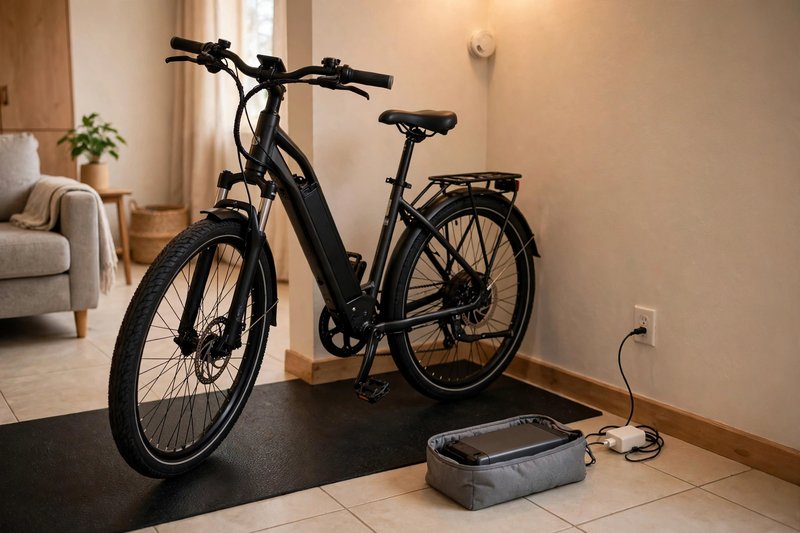
My first week with a heavy ebike nearly burned my living room rug. I learned safe indoor ebike storage after my hot charger melted that cheap carpet. That sharp plastic smell at 2 AM changed how I park at home.
Since that night, I tested six floor mats, three fire bags, and two racks. My current five-minute routine protects wood floors and keeps my lithium pack cool. You can copy my exact home setup today without spending a fortune.
What Most Guides Miss About safe indoor ebike storage
True indoor ebike safety starts with heat control and clear exits, not fancy racks. Most online guides only show neat wall hooks and ignore battery fire risks.
When I parked my wet bike near the front door, salt rusted my chain. Worse, a bad battery cell there would have blocked my only way out.
My 2 AM Wake-Up Call: Never set a warm charger brick on a rug or couch. My brick hit 135°F on plush carpet and scorched the fibers in one hour.
Three hidden indoor hazards caught me off guard during my first year of riding. You must fix these weak spots before you pick a parking corner.
Trapped charger heat: Power bricks need bare stone or tile to let heat escape fast.
Blocked exit paths: Parking in a front hall traps you inside if a cell vents smoke.
Damp frame drips: Rain and snow run down frame tubes and pool inside motor seals.
Cold charge damage: Plugging in a pack below 40°F harms internal lithium cells for good.
I tested popular internet storage tips in my apartment for six months. This table shows what failed in real life and what I do now.
| Common Advice | My Real-World Test | Better Move |
|---|---|---|
| Hang bike by front wheel | Bent my rim and tore drywall | Use a roll-in floor stand |
| Charge overnight while asleep | Brick hit 135°F without warning | Charge only while awake nearby |
| Store bike in cold shed | Freezing air cut range 30% | Keep battery indoors at 60°F |
| Leave battery on bike frame | Added 8 pounds of lift weight | Pull battery before parking bike |
Gear and Supplies I Actually Use at Home
You only need a fireproof battery bag, two stone tiles, and a smart plug. Skip heavy steel lockers that cost $400 and take up half your room.
I spent $300 testing storage gear before I cut my kit down to $85. Every item in my corner now protects my floor or blocks battery heat.
UL-rated fire bag ($35): A fiberglass pouch with double zippers holds my removed pack every night.
Ceramic floor tiles ($12): Two 18-inch stone tiles sit beneath my fire bag and charger brick.
Rubber boot tray ($15): A 4-foot tray with raised lips catches tire marks, salt, and oil.
Smart timer plug ($12): This simple outlet cuts power after two hours so packs never overcharge.
Wall smoke alarm ($15): I stuck a loud photoelectric alarm right above my charging tile zone.
My $12 Tile Trick: Skip $90 fire mats sold by bike shops. Two thick ceramic floor tiles from a hardware store cost $12 and block high heat.
I tried four indoor racks and floor setups in my 700-square-foot apartment. Here is how each option held up with a 65-pound commuter frame.
| Option I Tried | Best Use Case | My Honest Verdict |
|---|---|---|
| Roll-in wheel stand | Heavy step-through frames | Best daily pick with zero lifting |
| Vertical wall pivot rack | Bikes under 50 pounds | Great space saver with battery off |
| Ceiling pulley hoist | Tall garage ceilings | Too risky for heavy indoor bikes |
| Kickstand on rubber tray | Tight apartment hallways | Cheap, fast, and rock solid |
My Step-by-Step Workflow for safe indoor ebike storage
My five-minute routine separates the heavy bike frame from the battery pack right away. Doing these three stages in order prevents floor stains, back strain, and overheating.
Step 1: Prep Your Corner for safe indoor ebike storage
Pick a dry inside wall at least six feet from doors, heaters, and drapes. Never park or charge your bike inside a bedroom or main exit hall.
I cleared a 6-by-3-foot nook in my living room away from my front door. That clear zone keeps hot radiator pipes and fabric curtains far from my gear.
Measure six feet of clearance: Use a tape measure to check the gap from heaters, couches, and doors.
Lay down the rubber tray: Set your raised-lip boot mat flat against the baseboard to catch grime.
Set up the stone pad: Place two ceramic tiles two feet away from the tray for your battery.
Mount the wall smoke alarm: Stick your smoke alarm at eye level right above the stone tiles.
Step 2: Wipe Down Frame Moisture and Check Battery Heat
Pull the battery first, wipe wet tubes dry, and let the pack cool down. Removing the 8-pound battery makes rolling through tight doorways fast and easy.
Water and road salt sneak into brass pins if you leave the frame wet. I keep an old towel on my bike stand for a thirty-second wipe.
Turn off the display: Hold the power button for three seconds before touching the battery lock.
Unlock and lift the pack: Use both hands to pull the battery out before rolling indoors.
Dry the frame and pins: Wipe water off the down tube, motor shell, and brass pins.
Let warm cells cool: Rest the battery on your stone tiles for 30 minutes before charging.
Cold Battery Rule: Never plug in a battery right after a freezing winter ride. Wait two hours until the plastic shell feels warm to your bare hand.
Step 3: Lock In the Charge Level and Fire Bag
Store your pack at 50% to 80% charge inside a fire bag on stone. Only use the original UL-certified charger that came in the box with your bike.
Keeping a pack at 100% charge every night wears out cells in one year. Stopping at 80% doubled the lifespan of my commuter battery over 3,000 miles.
Check the LED bars: Aim for three out of five bars for daily and weekly indoor rest.
Set the smart plug timer: Plug your factory charger into the timer socket for two hours max.
Unplug the wall cord first: Pull the wall plug out before you disconnect the battery lead.
Seal the fireproof bag: Place the cool battery inside your fiberglass bag and zip both flaps.
Different storage timelines need specific charge targets and room heat limits. I keep this chart taped near my wall outlet as a quick guide.
| Size / Scenario | Exact Amount | How Often |
|---|---|---|
| Daily overnight rest | 50% to 80% charge | After every commute ride |
| Winter off-season rest | 40% to 60% charge | Check meter once monthly |
| Safe indoor room heat | 50°F to 70°F | All year round indoors |
| Post-ride cooling wait | 30 to 60 minutes | Before every single charge |
| Tire storage pressure | 15 to 20 PSI | Top off once monthly |
Shortcuts That Cut My Setup Time in Half
Small staging habits cut my indoor parking routine from ten minutes to three. You will stick to safe habits every night when your tools stay within reach.
Early on, I skipped wiping my bike because my rags stayed in a closet. Now every tool hangs right beside my rubber floor tray.
Put a bright cap on keys: Slip a neon cover on your battery key to spot it fast.
Clip a rag to the stand: Hang one dark microfiber towel on your bike rack for instant drying.
Back the rear wheel in: Roll backward into your corner stand to skip wide handlebar turns.
Use a wall cord magnet: Clip the charger tip to a magnet so cords stay off wet floors.
Here is my exact three-minute evening drill from front door to couch. Each step uses a simple shortcut to save time and back strain.
| Step | Time Needed | Key Shortcut |
|---|---|---|
| Pull battery outside door | 30 seconds | Key on stretchy wrist coil |
| Roll frame onto tray | 45 seconds | Back rear wheel in first |
| Wipe wet frame tubes | 60 seconds | Towel clipped to bike stand |
| Start timed charge cycle | 30 seconds | One-tap two-hour smart plug |
Where Indoor Storage Usually Goes Wrong
Most indoor mishaps happen when riders use cheap chargers or block exit doors. I made four costly errors in my first year before I fixed my space.
One hard drop on wood floors can crack internal battery cells without outside marks. If you ever drop a pack on hard tile, stop using it right away.
| My Early Mistake | What Happened | What I Do Now |
|---|---|---|
| Bought a $19 web charger | Melted plastic plug in week two | Use only factory UL charger |
| Parked tires on bare oak | Left two black rubber stains | Park on raised rubber tray |
| Stored pack at 100% charge | Lost 20% range by spring | Rest pack at 60% charge |
| Lifted bike with pack on | Strained my lower back twice | Pull 8-pound battery outside |
Hallway Exit Rule: Would you have to step over your bike to escape a sudden fire? If yes, move your bike and battery to a back corner today.
How I Spot Battery Hiccups in Two Minutes
Use your eyes, nose, and bare hand to catch battery trouble early. A healthy lithium pack stays flat, quiet, odor-free, and cool to the touch.
| Warning Sign | Real Cause | My 2-Minute Fix |
|---|---|---|
| Sweet chemical smell | Leaking internal cell gas | Move pack outside onto concrete |
| Swollen plastic shell | Gas buildup inside cells | Recycle at hazard drop site |
| Charger flashes red | Wet or dirty brass pins | Unplug and wipe with cloth |
| Pack hot while resting | Internal short circuit risk | Place outside in sand bucket |
My Weekly and Monthly Maintenance Habit
A five-minute Sunday check keeps your bike ready and prevents slow battery drain. Batteries lose a tiny bit of power each week even when turned off.
Neglecting a stored bike for three winter months killed my neighbor’s $600 battery pack. My simple calendar habit keeps my cells fresh and my tires round all year.
Press the battery test button (Weekly): Check that the LED meter shows two to four lit bars.
Touch the unplugged shell (Weekly): Run your hand over the case to check for heat or bulges.
Spin both tires half a turn (Monthly): Rotate wheels on the tray so rubber flat spots never form.
Squeeze both tires by hand (Monthly): Pump tires to 20 PSI so heavy rims never pinch tubes.
My First-Sunday Habit: I check my stored battery on the first Sunday of every winter month. A quick 15-minute boost keeps the pack near 50% until spring arrives.
FAQs for safe indoor ebike storage
Can I keep my ebike in my bedroom at night?
Never store or charge an ebike inside your bedroom at night. Keep the bike in a main room at least six feet from exit doors.
What battery charge level is best for winter storage?
Keep your ebike battery between 40% and 60% charge for winter. Check the meter each month and add a short boost if it drops.
Should I leave my ebike battery plugged in all the time?
Unplug your ebike battery within 30 minutes of hitting a full charge. Leaving a charger on all week heats the cells and adds fire risk.
What room temperature is safest for an indoor ebike?
Store your ebike and battery in a dry room between 50°F and 70°F. High heat or freezing air harms cell health and cuts your riding range.
Do fireproof battery bags actually stop ebike fires?
A UL-rated battery bag slows down flames and thick smoke for 30 minutes. Pair the bag with a stone floor pad so heat never burns wood floors.
How do I protect apartment floors from heavy ebike tires?
Place a dense rubber mat with raised edges under both ebike wheels. This blocks black tire marks, road salt, and chain oil from wood floors.
My Final Rule for Worry-Free Home Bike Parking
Treat your ebike battery like a camp stove when you park it indoors. Once I gave my pack a stone pad and fire bag, my worry vanished. Smart safe indoor ebike storage comes down to clear exits and timed charging.
Walk over to your ebike right now and spend five minutes checking its spot. Move the charger off rugs, clear six feet of space, and unplug full packs. That five-minute shift protects your home, your floor, and your ride for years.

Leave a Reply